
Muse says its email address is rolling out more widely. That is not access to your inbox.
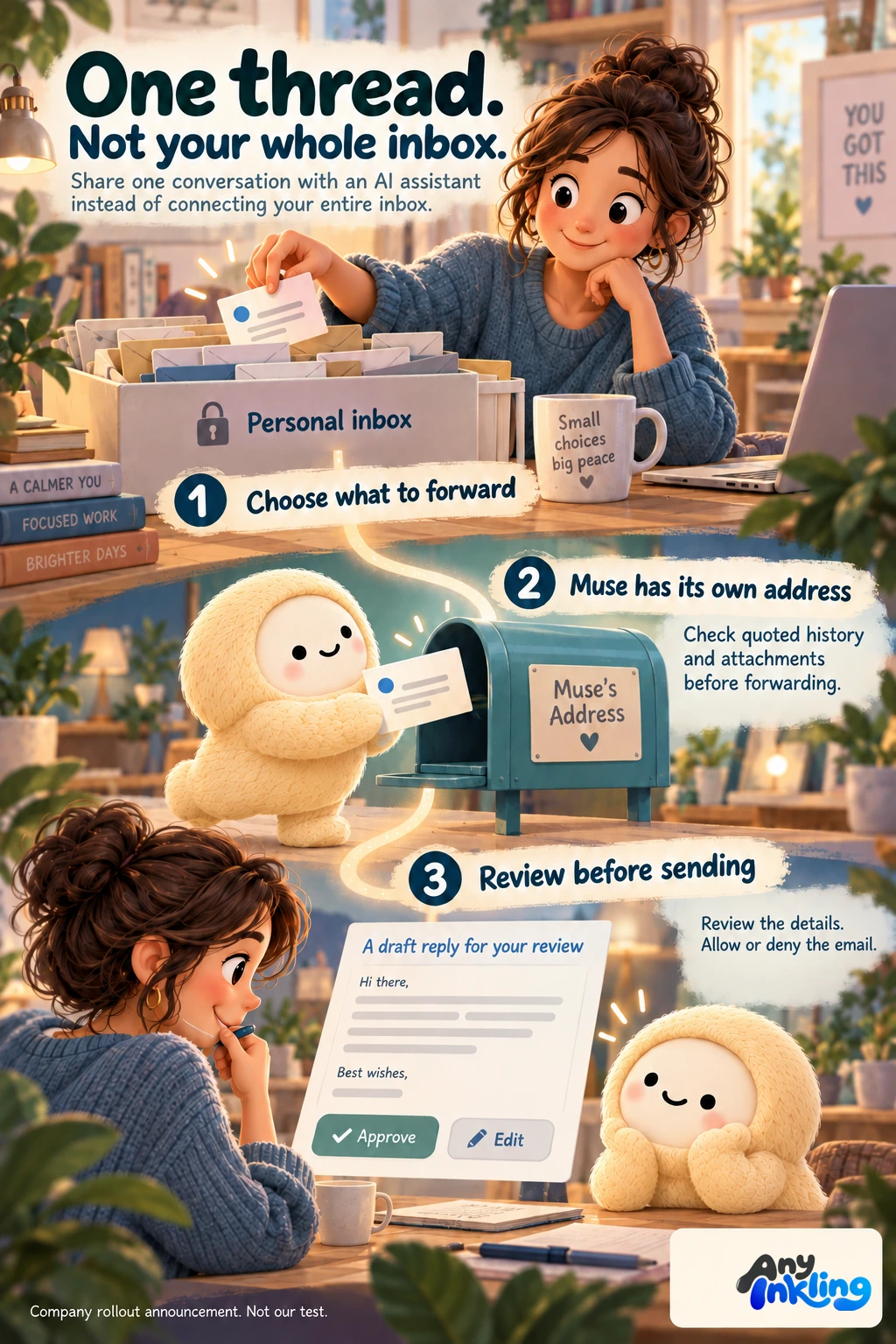
Muse says its own email address is rolling out to everyone in supported markets. The practical distinction is what you share: forwarding a selected conversation is different from connecting an entire personal inbox.
- In a 20 November company post, Muse says its own address can send and receive email on your behalf. The post points people to the mail tab in the app or tells them to ask Muse.
- The address is separate from Gmail, Outlook or another personal inbox. Meta says setting it up does not grant access to those inboxes. You can choose emails to forward instead.
- Meta says you can verify an external address you own to send Muse instructions by email. That is another way to give instructions, not an inbox connection. Use an account only you can access; anyone who gets into it could send requests.
- The company post does not name the supported markets or explicitly specify free-plan access. We have not verified availability in Malaysia or for a particular account.
- The development is a wider-rollout statement, not the invention of a new inbox. Any Inkling already covered the reported paid US and Canadian rollout, a Japan single-account test and an earlier promise of expansion.
- For someone who does not want to connect a whole inbox, selected forwarding offers a narrower way to provide context for an individual task. The trade-off is that you must choose the context and check what else the thread includes.
- An agent address also changes what the recipient sees. Meta says these emails come from your agent. Sending from your personal account is a separate connected-account choice, not something this address automatically provides.
- Our takeaway: begin with one bounded thread, say what the assistant may ask or share, and keep any booking, payment or other commitment explicit. Meta gives restaurant inquiries and refund follow-ups as examples, not proof that those tasks were completed successfully.
- Review the proposed email details when Muse asks. Its documented flow lets you allow or deny the action and request changes. The person receiving it can reply from their usual email account without having Muse.
- Before forwarding, inspect quoted history and attachments for other people's information. Do not assume deleting the email later erases everything: Meta says Muse may retain learned information, and recipients may keep their copies.
- This is for individual communication and delegated tasks, not bulk campaigns. Sending limits apply. A rollout announcement and help pages do not establish reliable completion, accuracy or time saved.
Generated illustration with fictional people and conceptual controls, not a product screenshot or our email test.
No account setup, message send, refund, reservation or delivery was tested for this article. Supported-market scope, account eligibility and explicit free-plan terms remain unverified. This is company-announced expansion with practical guidance, not a first-launch claim.
Editorial difference: The new point is the dated company statement that rollout is now underway more widely, compared with the earlier promise. The selective-forwarding explanation supplies the practical consequence. Secondary coverage is counted once with its original announcement.
Muse, original rollout post ↗
20 November 2026, 10:22:14 MYT /02:22:14 UTC. Company announcement, not a completed-task test.
Meta Help: About Muse email addresses ↗
Current product and permission guidance. Displays updated a week ago, not an exact launch date.
Meta Help: Safely use an external email address ↗
Current security and account-ownership guidance.
The Tech Outlook, Estuti Bajpai ↗
20 November 2026, 12:17 IST /14:47 MYT. Secondary report of the same announcement, not independent adoption evidence.