
Business Standard's Tatkal test ends in a ticket after 30 platform rejections
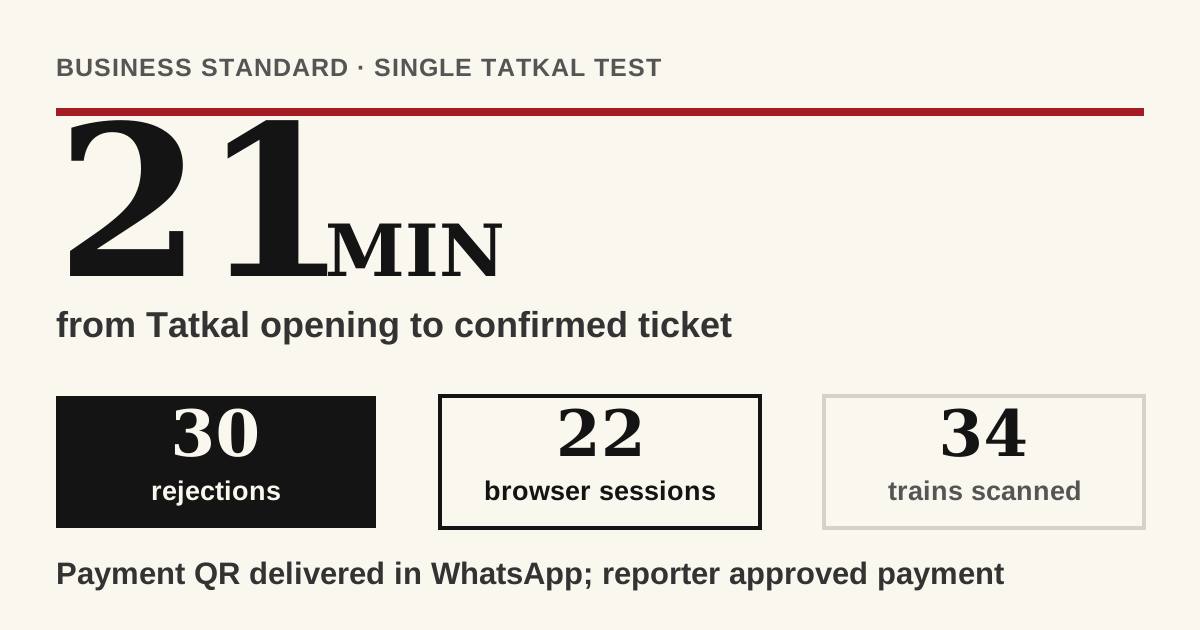
A Business Standard reporter gave Instinct a live, high-pressure Indian Railways Tatkal booking and documented both the access failure and the eventual confirmed ticket.
What happenedAjinkya Kawale says Instinct already had his IRCTC login details, saved preferences and vault password. Its logs show two crashes before browser launch. When the 10 am Tatkal window opened, IRCTC's bot filter rejected it 30 times across 22 browser sessions. It loaded the page 11 minutes after opening, scanned 34 Mumbai-Pune trains at 10:14 am, moved from the unavailable Deccan Express preference to the Udyan Express fallback within 18 seconds, then generated a UPI QR code via WhatsApp chat. Kawale entered his PIN, paid, and received a confirmed middle-berth ticket in the chat 21 minutes after the window opened.
Why it mattersThis is a concrete time-sensitive workflow with a useful division of control: the agent handled the searching, fallback and checkout preparation, while the traveler kept the payment step through his own UPI PIN. It also shows why agent identification is now a platform issue, not just a product issue.
Evidence limitsThis is one reporter's first-person test, not a reliability rate or an Any Inkling benchmark. Business Standard reports that IRCTC blocks roughly 46 per cent of incoming traffic as suspected machines and that NPCI is building a Unified Agent Protocol; those are the article's claims. IRCTC did not respond to the publication's queries.