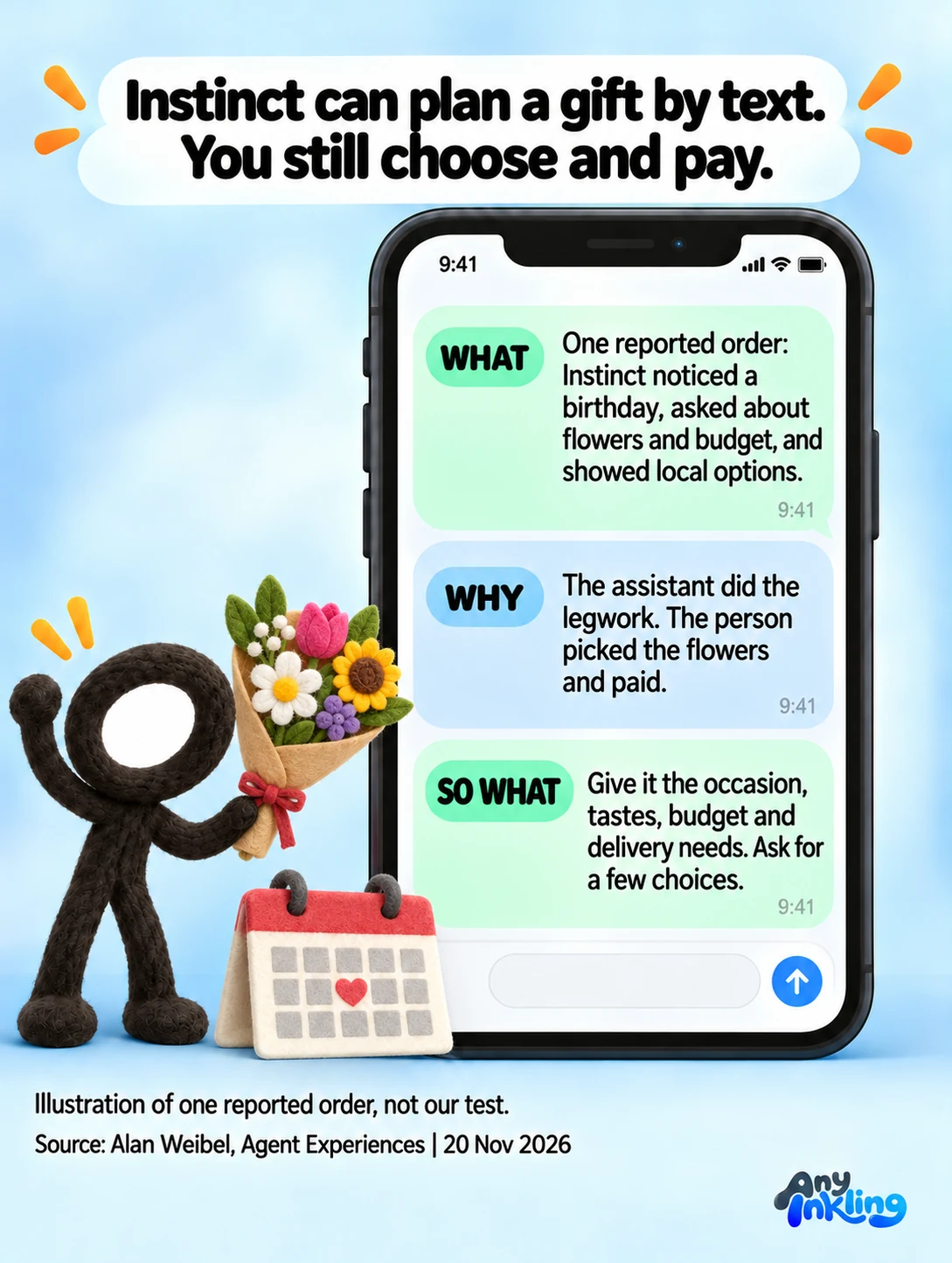
Alan Weibel describes Instinct spotting an upcoming birthday, asking about flowers and budget, and bringing arrangements from a local florist onto one page. The card message and remaining details were settled by text.
What
Weibel writes that Instinct, connected to his Gmail and family calendar, noticed his wife's birthday a week ahead and asked what he had planned. He already had dinner booked. It suggested flowers and asked which flowers she liked and what he wanted to spend.
According to his account, Instinct made one page of arrangements from a local independent florist, within his budget. That was the only page of choices he opened. He selected an arrangement and paid the bill using Shop, Shopify's payment app.
He says the flowers went out with a note, with the card message and remaining details handled by text. He approved each step, and nothing was bought before he said yes.
Why
A reminder alone leaves the next task with you. This account connects the reminder to a short list: notice the occasion, ask for the missing preferences, then bring back choices to review.
The useful detail is the small amount of browsing Weibel reports: one page of local arrangements, rather than a search across separate florist websites. The account does not establish how many shops Instinct considered or how much time it saved.
So what
Our takeaway: for a gift, give the assistant the occasion, the recipient's tastes, your budget and delivery needs. Ask for a few choices instead of an open-ended "buy something".
Review the arrangement, full price, delivery details and card message together before approving the order. That gives you one clear decision rather than several loose ends.
Generated editorial infographic illustrating the reported flower-order workflow.
Source: Alan Weibel describes one order and dates it only to "this month". The piece promotes his own Agent Analyzer service, so he has a commercial interest. We did not repeat the order or check the receipt or delivery.
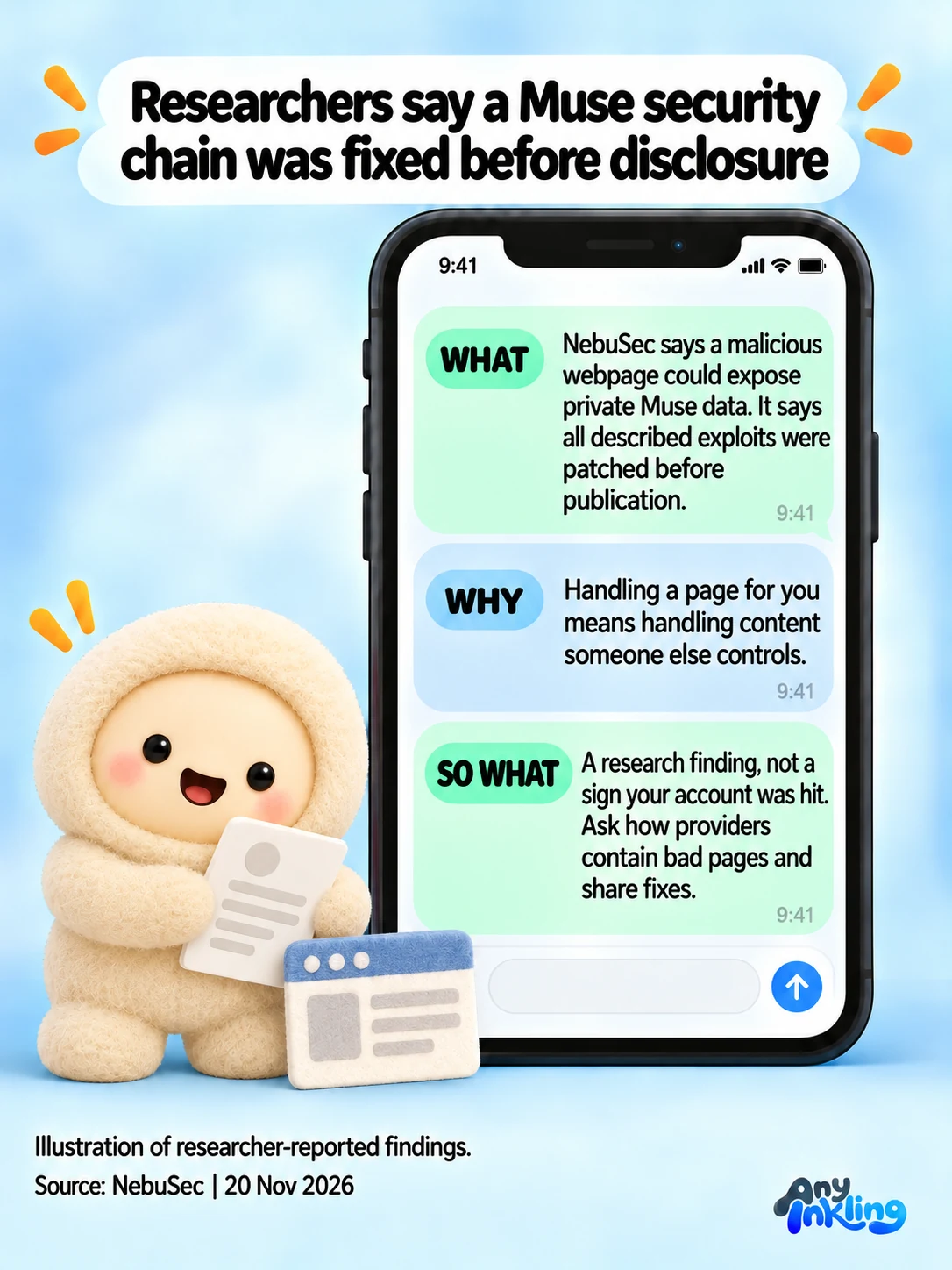
NebuSec published a report describing how an attacker-controlled webpage could expose private information inside a Muse user's environment. The researchers say all exploits they describe were patched before publication.
What
NebuSec, a security research firm, published a report on 20 November describing how an attacker-controlled webpage could expose private information inside a Muse user's environment. The researchers say all exploits described in the report were patched by the time of publication.
In their demonstration, having Muse export a malicious webpage gave them a route to read conversation history and memories without triggering a network approval prompt. They also report being able to change stored context and reach protected credential storage.
The researchers say the compromise stayed within one user's virtual machine. They say they did not demonstrate access to other users' environments or the underlying host.
Why
An assistant can handle an ordinary request, such as turning a webpage into a document, while meeting content someone else controls. This research is about why protecting the software that does that work matters alongside deciding what the assistant is allowed to do.
A permission prompt is not the whole security boundary.
So what
Treat this as a research finding the researchers say was fixed, not evidence that your own account was affected.
If you are choosing an assistant for sensitive work, a useful question is how the provider contains malicious content and communicates fixes, rather than only whether it asks before sending something.
Generated editorial infographic. Illustration of researcher-reported findings, not our test.
Source: NebuSec describes its own research, and the findings and patch status are researcher-reported. We have not reproduced the chain or verified vendor fix dates or versions, and the report does not establish real-world exploitation.
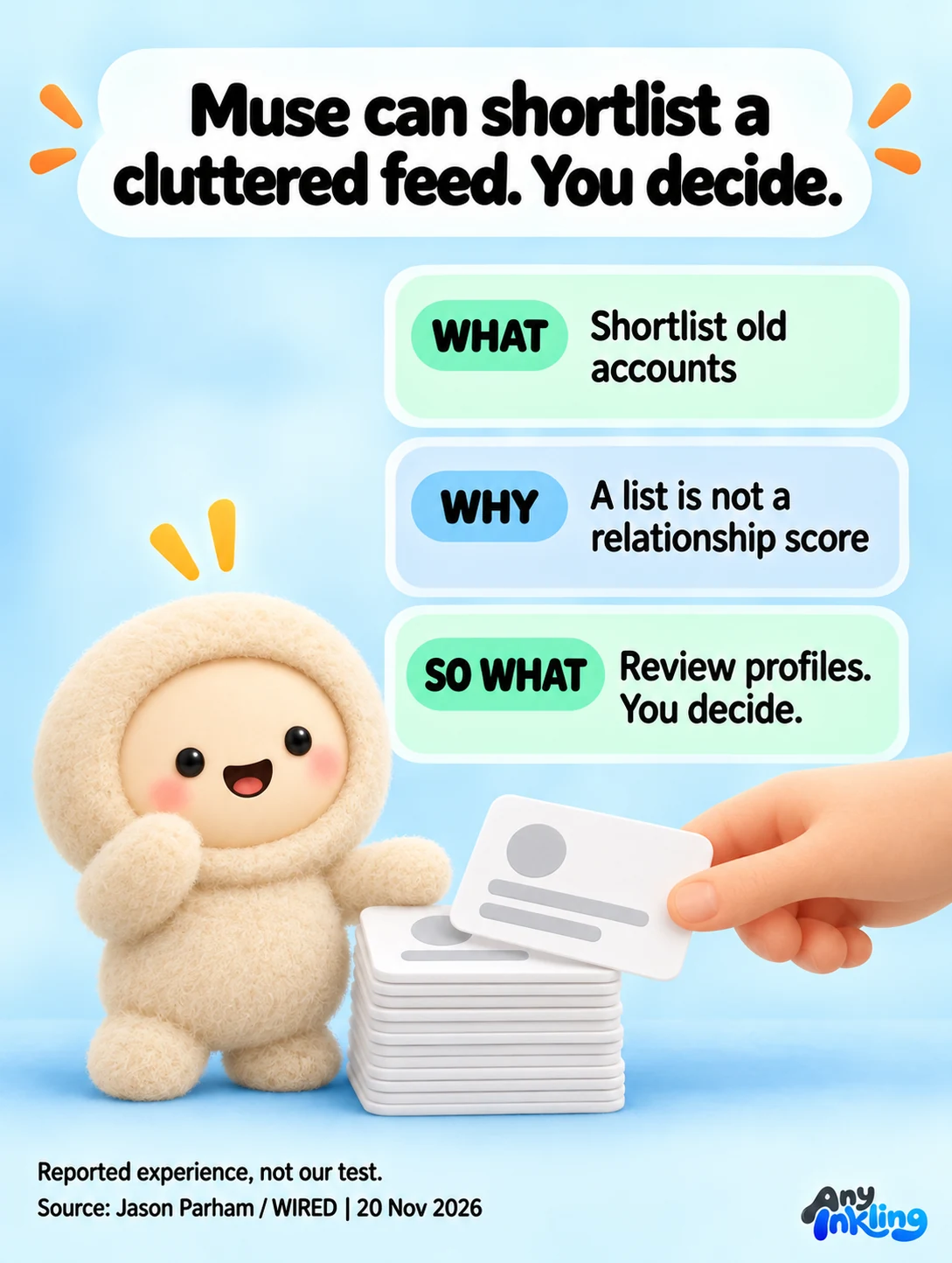
A new WIRED report describes people using Muse to sort Instagram accounts. Its most useful everyday example keeps the final choice with the person, rather than letting follower counts decide a relationship.
What
WIRED reports that people are using Muse to identify Instagram accounts they may want to unfollow. In an interview, Khalil Roberts says the assistant identified 151 accounts that did not follow him back, organized a spreadsheet with profile information and asked whether he wanted to proceed. The article places his cleanup on 7 November.
A different account in the report offers a less confrontational use. Elizabeth Brooks had accumulated giveaway accounts over roughly 10 years. She describes asking for five profile links at a time, no more than six batches a day, then manually unfollowing accounts one by one. Those are her reported instructions, not a tested recommendation about safe activity limits.
These are WIRED's interviews and reported experiences. We did not inspect the accounts, verify the lists or resulting follower state, or test Muse's accuracy. The reporting does not establish that every account can use the same workflow.
Why
A cluttered feed can be an organization problem rather than a relationship problem. A short list of old giveaway accounts gives a person something specific to inspect, instead of requiring a single decision about hundreds of profiles.
Finding candidates is different from deciding who matters. A non-reciprocal follow does not, by itself, establish that a friendship has ended or an account is no longer useful. In WIRED's report, social-connection researcher Natalie Pennington questions whether making such social data easy to retrieve makes it useful to know.
The distinction between an assistant's shortlist and an assistant's action matters here. Brooks's account keeps the unfollow action manual. That is a narrower reported workflow than asking an agent to purge an account list, but it is not independent proof of accuracy, privacy protection or freedom from platform restrictions.
So what
Our takeaway: if you want help reviewing a cluttered feed, define the practical category first, such as old giveaway accounts, rather than treating follower reciprocity as a score for your relationships. Ask for a small shortlist and inspect the profiles yourself before deciding.
Keep any instruction to act separate from the request to identify accounts. A proposed list is not a reason to approve every entry. We are not recommending automated mass-unfollowing or the batch frequency described in the interview.
Do not treat a first-person success story as a safety guarantee. Roberts's belief that using Muse would avoid spam flagging is not confirmation from Instagram about enforcement. WIRED also says Meta did not answer its question about a previously removed unfollower-tracking advertisement. Neither point establishes current permission or account-safety limits.
There is no measured time-saving result here. The useful distinction is smaller, reviewable information followed by a human choice, not a promise that an assistant can manage your social life correctly.
Generated editorial infographic. Conceptual illustration, not an Instagram screen, a real account list or our test.
WIRED displays 20 November 2026, 7:00 am, without a timezone we could verify. One central example occurred on 7 November, and the giveaway-cleanup account is not precisely dated. This is a new report about user experiences, not a new feature launch or proof that these tasks happened today.
No account connection, profile inspection, unfollow, platform-enforcement test or time-saving measurement was performed for this article. Interviewees' claims are attributed, not independently reproduced. We give no mass-unfollow instructions and no account-safety guarantee.
Jason Parham, WIRED ↗ 20 November 2026. Original reporting with attributed interviews, not an Any Inkling test.
Personal AI Agent NewsGeneral AI newsOpenAI Help; Engadget; 9to5Mac · 19-20 November 2026Product rollout and secondary reports, not our test
A wider plan rollout could put ongoing assistant work within reach of more people. It is not a promise that every subscriber can use it now.
What
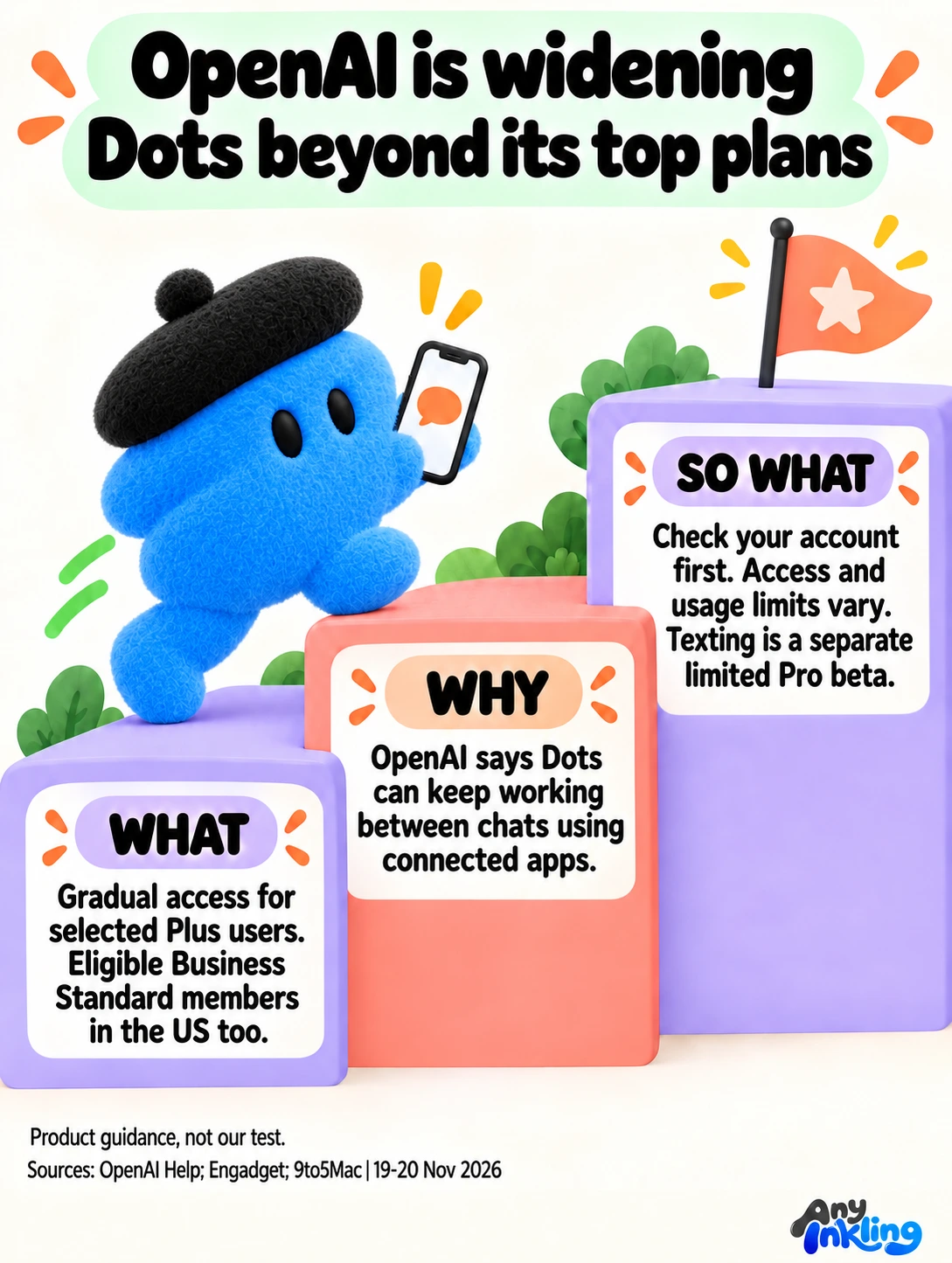
OpenAI's current help page says Dots are gradually reaching selected ChatGPT Plus users. It also says eligible Business Standard members in the United States are getting access. Account, region and workspace requirements still apply.
Dots already has eligible Pro users in supported markets. Texting is a separate beta for a limited number of Pro users in the US, Canada and Mexico, using iMessage or RCS. It is not supported in Business or Enterprise workspaces. Access through the selected Plus test does not by itself establish texting eligibility.
Engadget and 9to5Mac report a 19 November announcement by OpenAI engineering lead Thibault Sottiaux. This is an expansion of an existing agent, not the first launch of Dots.
OpenAI describes Dots as assistants that can keep working between conversations, using their own computer and apps you choose to connect. Those are product descriptions, not results from our test.
Why
The everyday change is access to ongoing work rather than another answer box: for example, maintaining research or carrying revisions across drafts. A plan name alone does not establish whether your account has the feature.
Some reports say the Business Standard rollout covers all users. The current primary help is narrower: eligible members in the United States. We use that primary scope instead of treating the headline as a global entitlement.
The rollout does not establish equal allowances across plans, permanent access for every test participant or reliable completion of a particular task. Usage limits apply.
So what
Our takeaway: check your account and workspace eligibility before upgrading or rearranging a workflow around Dots. OpenAI says support cannot switch the rollout on for an account and restarting the app will not unlock it.
If access reaches you, start with a bounded research or drafting job. State the output, deadline and decisions you want to keep. Review the result rather than equating background activity with finished work.
Review connected-app permissions separately from subscription access. OpenAI says a dot can proactively review connected information, and disconnecting an app does not delete information it already obtained.
We did not subscribe, set up a dot, connect an account or test a task. We have not verified access for a Malaysian account, and this article is not an upgrade recommendation.
Generated editorial infographic. Conceptual explanation, not the actual interface or our product test.
The existing wallet article covers purchase review and payment authorization. This article covers who can access an ongoing agent, with selected Plus accounts and US Business Standard eligibility kept explicit. The sources do not establish the exact original announcement time in MYT.
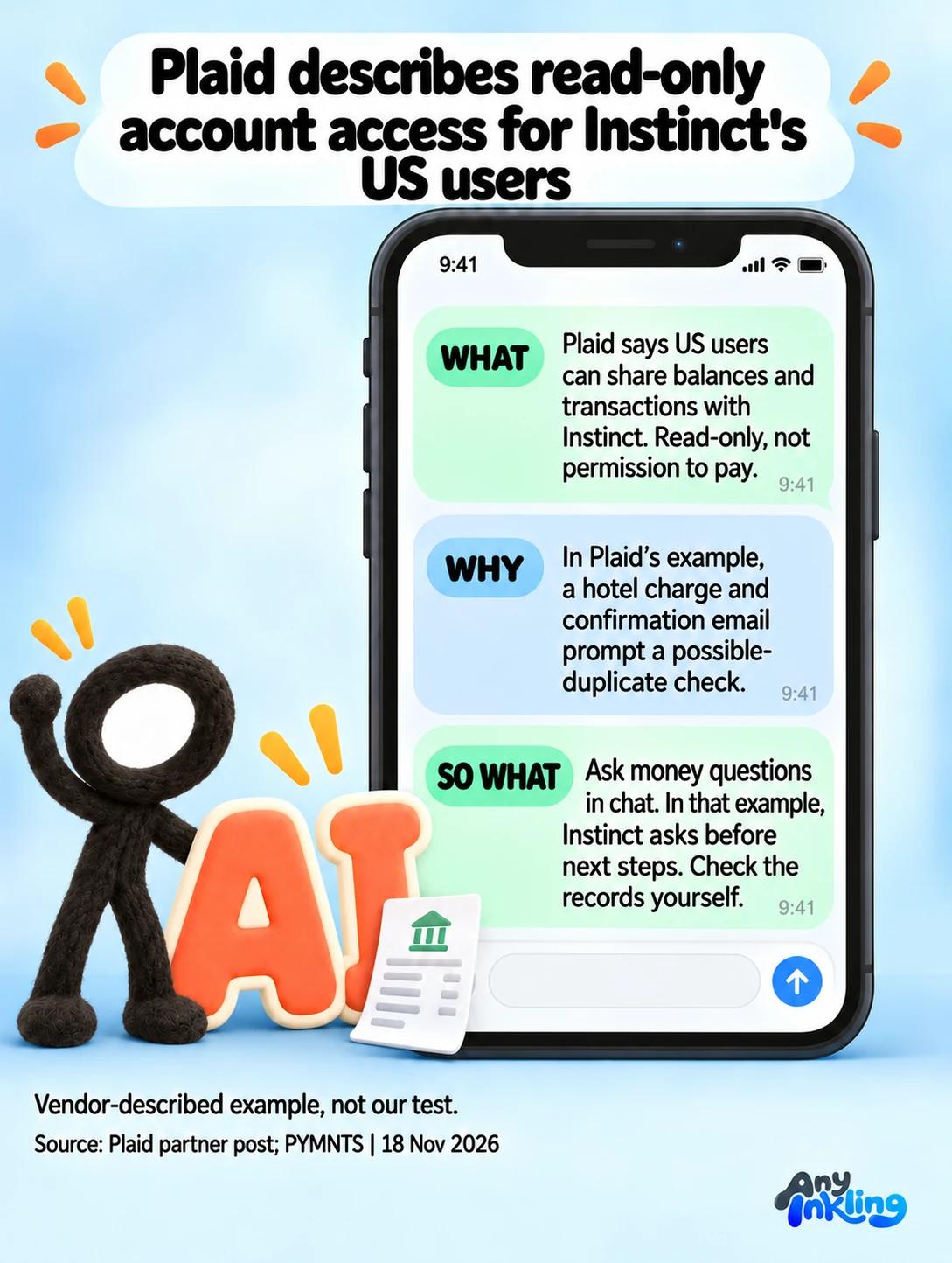
Plaid describes US account-data connections for questions about balances, transactions and refunds. The useful distinction is reading evidence versus authorizing what happens next.
What
In an 18 November partner post, Plaid says it provides read-only financial-account connectivity for US consumers using Instinct in iMessage and WhatsApp. This is dated company documentation, not proof that the integration first launched that day.
Plaid says users authenticate selected financial accounts, then Instinct can read balances and transactions alongside separately connected information such as email and calendar.
The post describes refund tracking, budgeting, grocery-expense splitting and a possible duplicate hotel charge. In the hotel example, the assistant offers to draft a dispute and asks before taking next steps. These are vendor-described scenarios, not independently verified completed cases.
Why
Account records can supply evidence for a financial question without making someone type every transaction. A hotel confirmation could help explain why two charges deserve a closer look, but a repeated amount is not by itself proof of an error.
Read-only financial data is different from a stored payment method or authority to move money. A connection that helps explain spending is not, on its own, permission to make a purchase, transfer funds, contact a bank or send a message.
The announcement concerns US consumers. It does not establish Malaysian-bank support, complete coverage of a person's finances, refresh timing, retention terms or accuracy on ambiguous transactions.
So what
Our takeaway: begin with one question, such as checking whether an expected refund appears. Review which institutions, accounts and data you are sharing. Add email or calendar only if that separate context is useful to the task.
Check dates, amounts, merchant names and whether an entry is pending or posted before treating a pattern as a problem. Keep the bank's own records as the reference for decisions about your money.
Ask for a draft or a list of questions first. Decide separately whether the assistant may send a dispute, share financial details or contact another person. The approval described in one vendor example is not an independent audit of every action.
No account was connected and no balance, refund, dispute or payment was tested for this article. We omit adoption percentages because they do not establish accuracy, successful refunds or the reasons people connected accounts.
Generated editorial infographic. Conceptual explanation, not the actual interface or our product test.
Existing Any Inkling stories cover Link shopping limits and a founder's card-linking adoption claim. This article explains the separate read-only account-data connection. It is an 18 November development prepared for review on 20 November, not a fresh launch relabelled for a newsletter link.
Plaid, Kathleen McGuirk ↗ 18 November 2026. Primary partner announcement, not an independent performance test.
PYMNTS ↗ 18 November 2026. Secondary reporting explicitly based on the Plaid post, not a separate task trial.
Muse AI newsPersonal AI Agent NewsMuse (company post) · 20 November 2026, 10:22 MYT / 02:22 UTCCompany rollout announcement
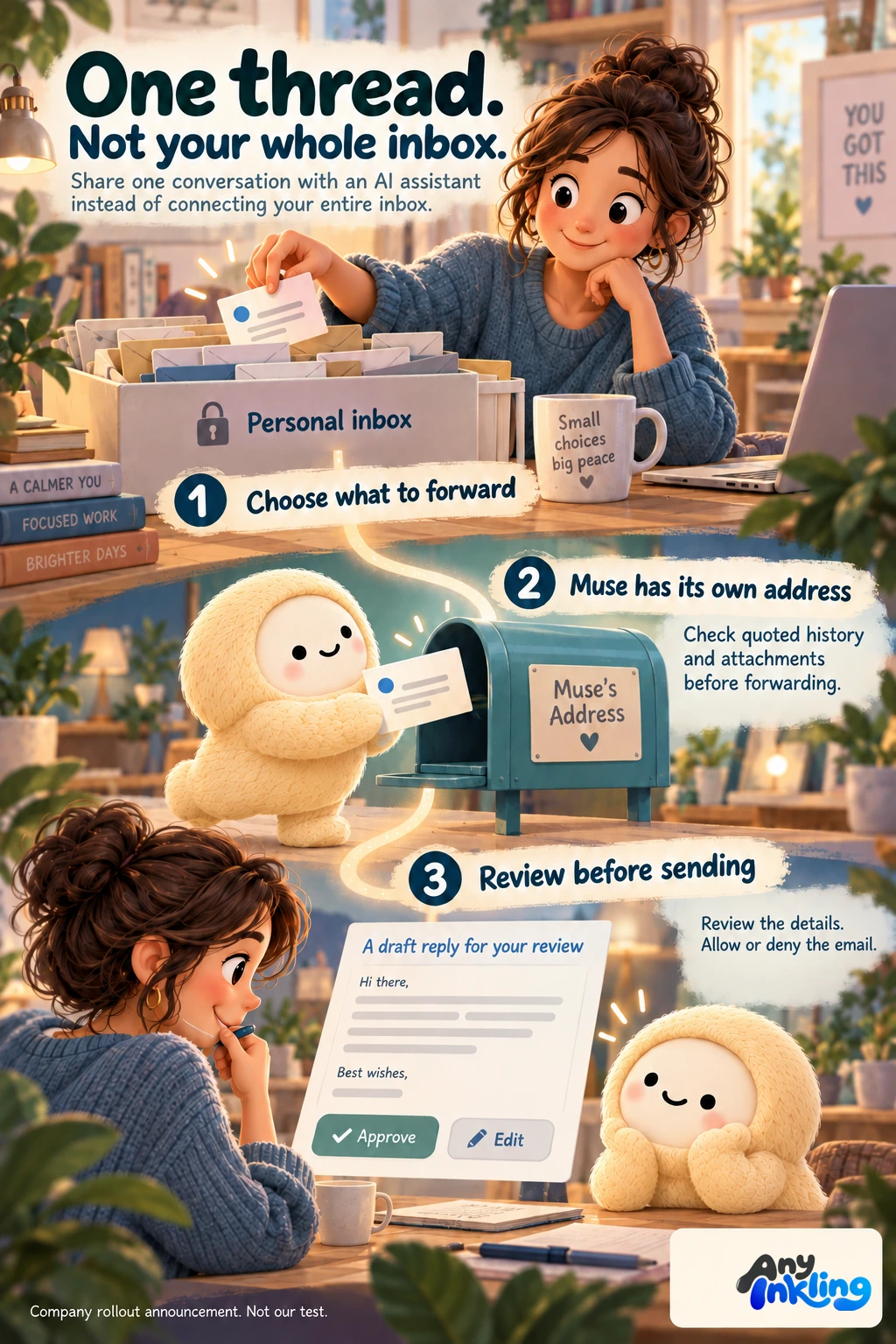
Muse says its own email address is rolling out to everyone in supported markets. The practical distinction is what you share: forwarding a selected conversation is different from connecting an entire personal inbox.
What
In a 20 November company post, Muse says its own address can send and receive email on your behalf. The post points people to the mail tab in the app or tells them to ask Muse.
The address is separate from Gmail, Outlook or another personal inbox. Meta says setting it up does not grant access to those inboxes. You can choose emails to forward instead.
Meta says you can verify an external address you own to send Muse instructions by email. That is another way to give instructions, not an inbox connection. Use an account only you can access; anyone who gets into it could send requests.
The company post does not name the supported markets or explicitly specify free-plan access. We have not verified availability in Malaysia or for a particular account.
Why
The development is a wider-rollout statement, not the invention of a new inbox. Any Inkling already covered the reported paid US and Canadian rollout, a Japan single-account test and an earlier promise of expansion.
For someone who does not want to connect a whole inbox, selected forwarding offers a narrower way to provide context for an individual task. The trade-off is that you must choose the context and check what else the thread includes.
An agent address also changes what the recipient sees. Meta says these emails come from your agent. Sending from your personal account is a separate connected-account choice, not something this address automatically provides.
So what
Our takeaway: begin with one bounded thread, say what the assistant may ask or share, and keep any booking, payment or other commitment explicit. Meta gives restaurant inquiries and refund follow-ups as examples, not proof that those tasks were completed successfully.
Review the proposed email details when Muse asks. Its documented flow lets you allow or deny the action and request changes. The person receiving it can reply from their usual email account without having Muse.
Before forwarding, inspect quoted history and attachments for other people's information. Do not assume deleting the email later erases everything: Meta says Muse may retain learned information, and recipients may keep their copies.
This is for individual communication and delegated tasks, not bulk campaigns. Sending limits apply. A rollout announcement and help pages do not establish reliable completion, accuracy or time saved.
Generated illustration with fictional people and conceptual controls, not a product screenshot or our email test.
No account setup, message send, refund, reservation or delivery was tested for this article. Supported-market scope, account eligibility and explicit free-plan terms remain unverified. This is company-announced expansion with practical guidance, not a first-launch claim.
Editorial difference: The new point is the dated company statement that rollout is now underway more widely, compared with the earlier promise. The selective-forwarding explanation supplies the practical consequence. Secondary coverage is counted once with its original announcement.
Muse, original rollout post ↗ 20 November 2026, 10:22:14 MYT /02:22:14 UTC. Company announcement, not a completed-task test.
The Tech Outlook, Estuti Bajpai ↗ 20 November 2026, 12:17 IST /14:47 MYT. Secondary report of the same announcement, not independent adoption evidence.
Muse AI newsPersonal AI Agent NewsAlexandr Wang / Meta · 20 November 2026, 09:38 MYT / 01:38 UTCCurrent-capability explainer
Muse's Chrome sidebar brings the assistant alongside the page you are using. The practical change is access: Meta says it can work through accounts already signed in to your personal Chrome, so knowing what is open matters as much as knowing how to pause it.
What
Alexandr Wang called attention to the Muse Chrome extension on 20 November at 09:38 MYT, describing his announcement as belated. TestingCatalog had already reported the store listing on 13 November. This is a fresh announcement of an existing extension, not evidence that the capability launched today.
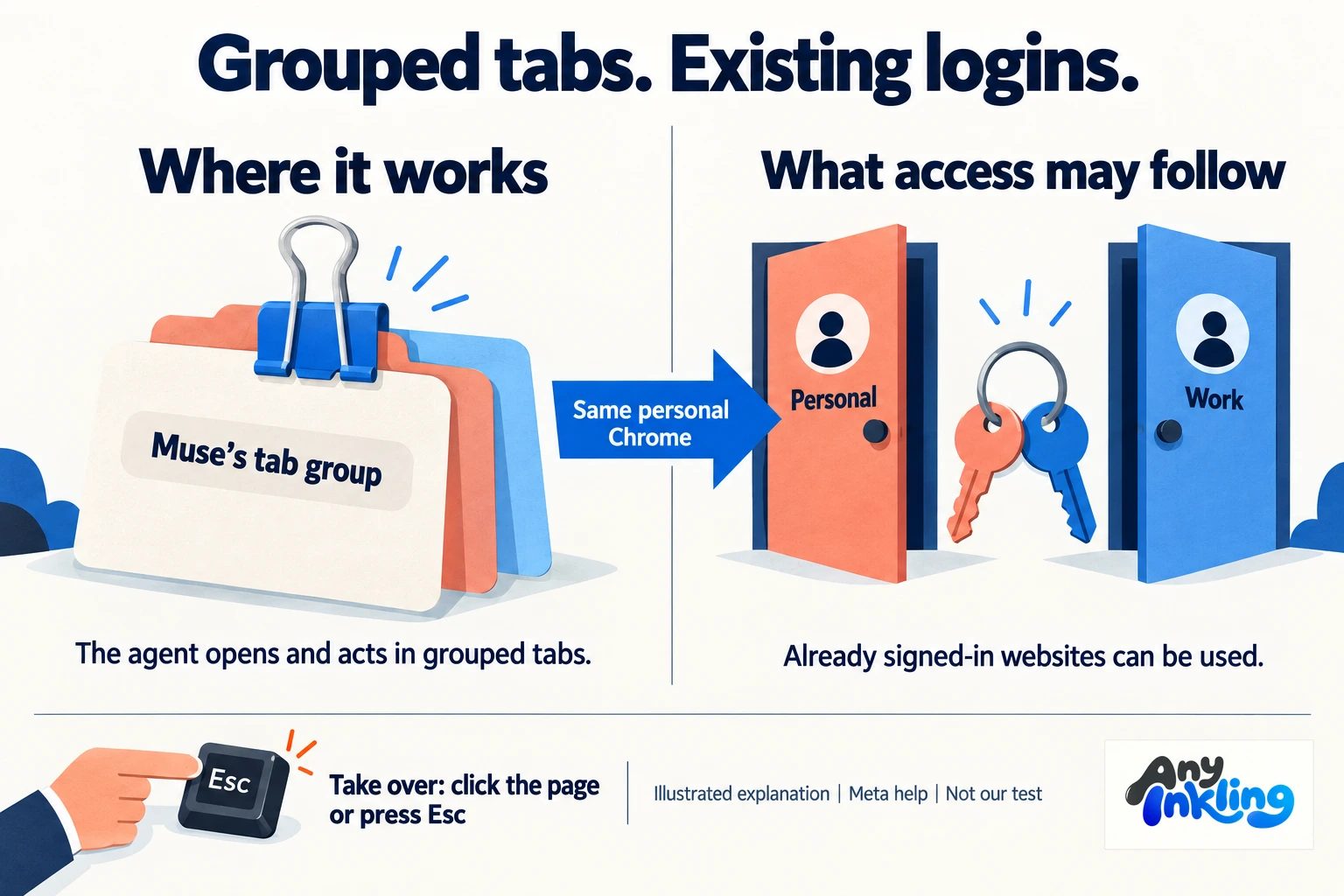
Meta's help page says the extension puts Muse in Chrome's side panel. Muse opens tabs in its own group and can act in those tabs using your personal Chrome, including websites where you are already signed in.
Why
The useful difference is working alongside the page instead of moving the task into a separate browsing session. Meta lists forms, purchases and appointment bookings among its browsing uses; those are described capabilities, not tasks we have tested through this extension.
An existing login is useful access, not a fresh permission decision each time. Meta says Muse can use signed-in websites without asking for login details again. An account you leave open may therefore be available to the agent while it works in its grouped tabs.
So what
Our takeaway: check which accounts are signed in before connecting the extension. Meta specifically advises logging out of accounts you do not want Muse to use. State the task's limits and check the proposed action before allowing a consequential step.
Know the takeover controls before starting: Meta says clicking the page, pressing Esc or moving a tab out of the Muse group pauses its activity or lets you take over. Watch the work rather than treating the sidebar as proof that it is correct.
Keep access separate from privacy guarantees. Meta says saved passwords, browsing history and Chrome settings are not visible to Muse and webpage passwords are removed from text. It also says activity may be attributed to you and affect ads or recommendations. The store declares data categories including web history, authentication information and website content.
Generated conceptual comparison: grouped task tabs beside already signed-in personal and work accounts, with an Escape-key takeover control. This is not an isolation guarantee or a product screenshot.
The original X post is dated 20 November 2026, 01:38:38 UTC, equivalent to 09:38:38 MYT. Wang's own belated wording and TestingCatalog's 13 November article establish announcement versus prior discovery. Digital Trends supplies context; its displayed 19 November 9:49 PM has no verified timezone here and is not used to date the announcement. Meta help and the Chrome Web Store establish the described access/control model, not independent security or task-success proof. Store privacy categories describe declared collection and use; they are not the same claim as model visibility into saved browser history. We did not install, connect or test the extension, grant account access, book, buy or measure savings. No claim about Malaysian eligibility, subscription terms, a universal approval requirement or guaranteed merchant support is made. The artwork is a generated explanation with fictional people and a stylised browser, not a product screenshot.
A Mediaweek interview describes a parent using Muse to move from remembering a party to preparing a gift or costume purchase. The useful boundary is the handoff: a cart is ready for inspection, not proof that the errand is finished.
What
In a Mediaweek interview, Australian parent Alice Mouritz says Muse flagged an upcoming children's birthday party, asked about a gift, searched local retailers and prepared a cart. She says it did the same for a costume her children needed.
The handoff stopped before payment: Mediaweek says Mouritz completed that herself. The article describes two weeks of use after Meta invited local creators to try Muse before launch and provide feedback.
Why
The practical step beyond a reminder is preparation. Finding options and assembling a cart can remove some browsing from a busy morning, while leaving the final purchase with the parent. That is the workflow she reports, not a measured time-saving result.
A prepared cart is not a finished errand. The account does not independently establish the items, prices, final order or delivery. Her description of doing another task at the same time is not evidence that productivity doubled.
So what
Our takeaway: make the handoff explicit. Ask for options or a prepared cart, state the budget, delivery deadline and constraints, and say which substitutions need another check. Preparation and permission to pay are different decisions.
Before completing checkout, inspect the actual item, quantity, total including delivery, arrival estimate and return terms. A birthday reminder does not establish that a gift will arrive in time or that a costume is the right size.
Treat this as one invited participant's experience, not a guarantee of merchant support, accuracy or local access. The interview does not establish availability in Malaysia or that the same workflow will work for your accounts.
Generated illustration of a reported reminder-to-cart workflow, with inspection and payment kept by the parent. Fictional family, not a product screenshot or a tested transaction.
Nama Winston's Mediaweek interview was published on 20 November 2026. Its article metadata and structured data agree on 02:50:44 UTC, equivalent to 10:50:44 MYT. The article says Meta invited local creators to test Muse before launch and provide feedback, and describes Mouritz's two-week use. It does not establish here whether she was paid. We found no explicit paid or sponsored label in the article text inspected; that does not prove unpaid participation. Photos are supplied and are not reused here. We have not independently checked a cart, payment, order, delivery, accuracy or time saving. General partner, security, advertising, model-training, approval-policy and subscription claims in the source are not adopted as independently verified facts. The shopping examples are reported experiences, not a new feature launch or our product test.
Muse AI newsPersonal AI Agent NewsReuters / The Information; timestamp: Jay Peters / The Verge · 20 November 2026, 04:22 MYT / 19 November, 20:22 UTCReported price, not confirmed offer
A fresh report puts a possible price on Meta's small Muse device. It may reduce the steps needed to reach an assistant, but buyers still need confirmed service terms and availability.
What
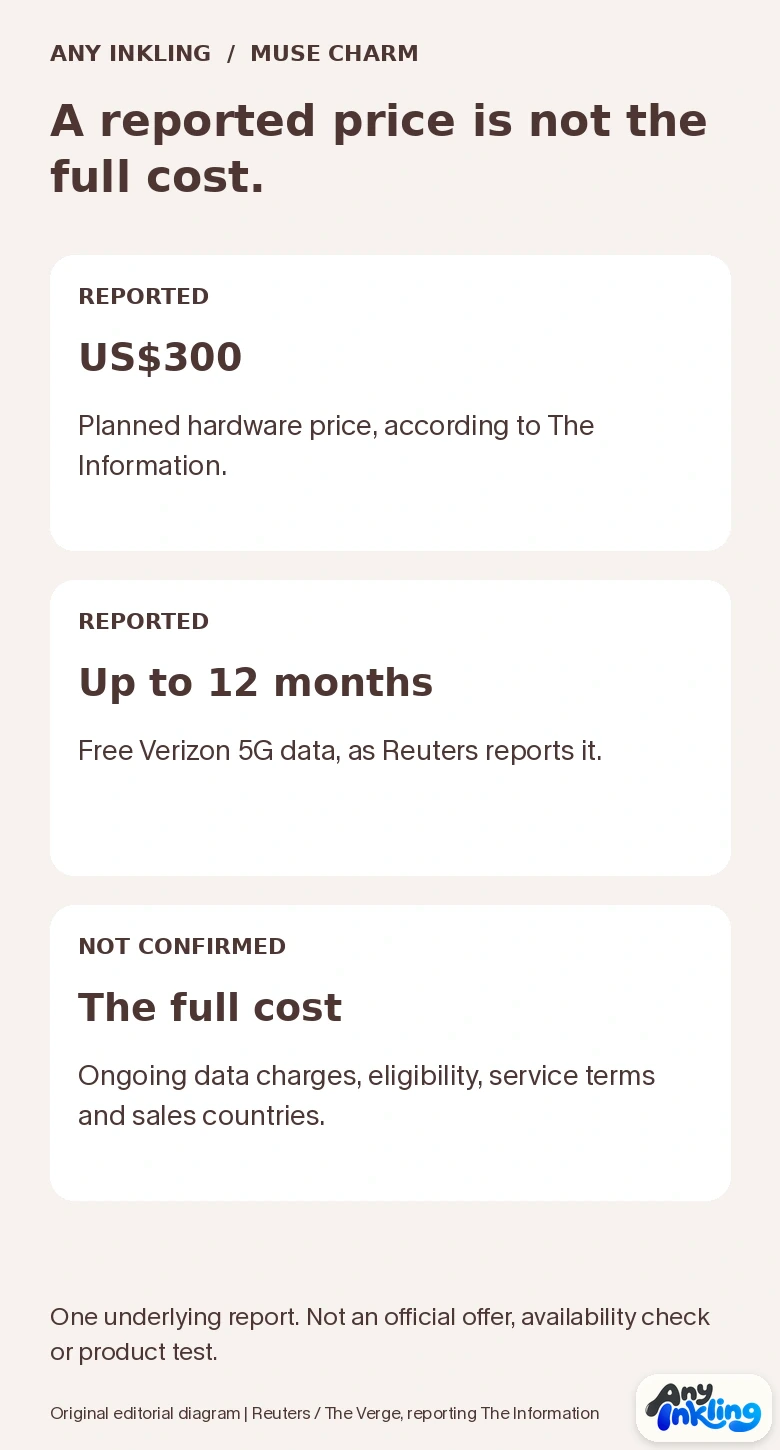
Meta plans to price Muse Charm at US$300, The Information reports, citing a person familiar with the matter. Reuters and The Verge repeat that report. They are not separate confirmations of the price.
Reuters describes up to 12 months of free Verizon 5G data. The Verge says 12 months; we use the narrower 'up to' wording. Meta's response to The Verge does not confirm a price or launch date.
Why
Charm is intended to make Muse easier to reach: tap a small device and speak, rather than unlock a phone and open an app. That is an access benefit proposed for an earlier-announced device, not evidence that it completes errands more accurately or saves time.
A reported hardware price does not settle the total cost. The reports do not establish the continuing data charge, eligibility for the included service, local availability or which Muse plan a buyer would need.
So what
If you already reach your assistant easily from your phone, another device needs to earn its place. Wait for confirmed ordering, connectivity and service terms before treating US$300 as the full cost.
For anyone considering a dedicated device, check where it works, how it handles information around other people, and which actions still need approval. These are our questions for the final product, not verified defects or security guarantees.
There is no confirmed Malaysian availability in the sources reviewed. The earlier December holiday-shipping expectation is not an exact shipping date or a promise that orders are open.
Reported hardware price US$300 and up to 12 months of Verizon data, with ongoing cost and availability still unconfirmed. Original editorial diagram, not a product image or offer.
Lead coverage: Reuters, reporting The Information's unnamed-source pricing claim; carried by Investing.com on 19 November 2026. The page shows 15:16 and an update at 15:18 without an established timezone here, so no exact MYT time is claimed for that page. The Verge's Jay Peters published at 20:22 UTC on 19 November, equivalent to 04:22 MYT on 20 November. That is the verified same-day-MYT reporting timestamp used here. We could read only the headline and byline of Jyoti Mann's original Information article, not its full text. TechCrunch also attributes the price to The Information and reports the same noncommittal Meta response; it is not independent price confirmation. Charm was announced earlier. This is a reported-price development, not a new device launch, a hands-on test or a completed shopping or travel task. We have not verified final specifications, battery life, sales countries, purchase eligibility, subscription requirements, recurring charges or an exact shipping date.
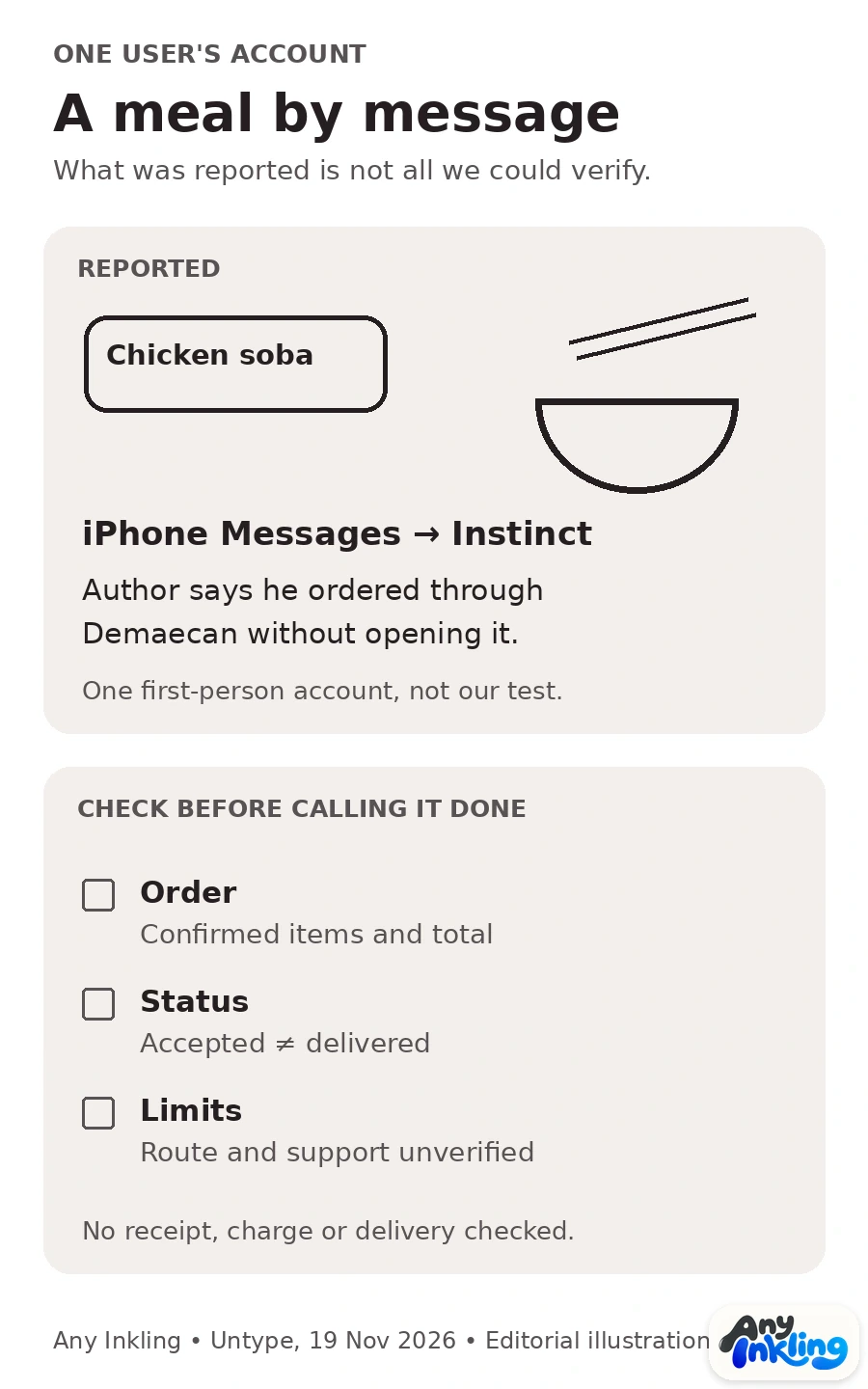
An Untype practitioner describes asking for food through iPhone Messages. His account makes a simple case for delegating an everyday chore, but it is not independent proof of delivery or a promise that every shop works.
What
In a Japanese-language post published on 19 November, Untype's Taro Yamashita says he used Instinct to order chicken soba through Demaecan without opening the service himself. He says he uses Instinct through the iPhone Messages app.
This is his first-person account. He explicitly says he did not verify which screens or internal route Instinct used. We have not repeated the order or independently checked a receipt, total charge or delivery.
Why
The everyday benefit is easy to understand: tell an assistant what you want instead of starting with a delivery website and working through its screens. That is the author's reported experience, not a timed comparison or evidence that every step was autonomous.
His enthusiasm comes with hesitation about giving access to accounts. He also reports that an Amazon attempt did not work. Neither experience establishes a general compatibility list, an explanation for the failed attempt or a security assessment.
So what
Our takeaway: begin with one bounded chore. Separate asking for meal options from permission to order. State the restaurant or acceptable choices, quantities, dietary needs, delivery details and maximum total, then say which changes need another check.
Before treating an order as done, ask for its confirmed contents, total and order status. An assistant's progress update is not a substitute for confirmation, and an accepted order is not proof that the food arrived.
This is an account from one user in Japan, not a rollout announcement. Do not assume the same merchant, country, account or payment setup will work for you.
One user reports a soba order by message; receipt, charge, delivery and execution route are not independently verified. Original editorial illustration, not a product screen or delivery proof.
Source read in Japanese on 19 November 2026. The page identifies its author as Taro Yamashita and labels the piece as his experience. Its publication metadata is 19 November 2026 at 02:25:30 UTC, which is 10:25:30 MYT and 11:25:30 JST; the date of the actual order is not established. We have not verified delivery, cost, merchant-wide support, the internal execution route or security. Policy summaries, funding claims and proposed reasons for the Amazon failure are not used as established facts here.
Muse AI newsPersonal AI Agent NewsMuse / Alexandr Wang · 19 November 2026, 03:56 MYT / 18 November, 19:56 UTCCompany announcement, not our fitting test
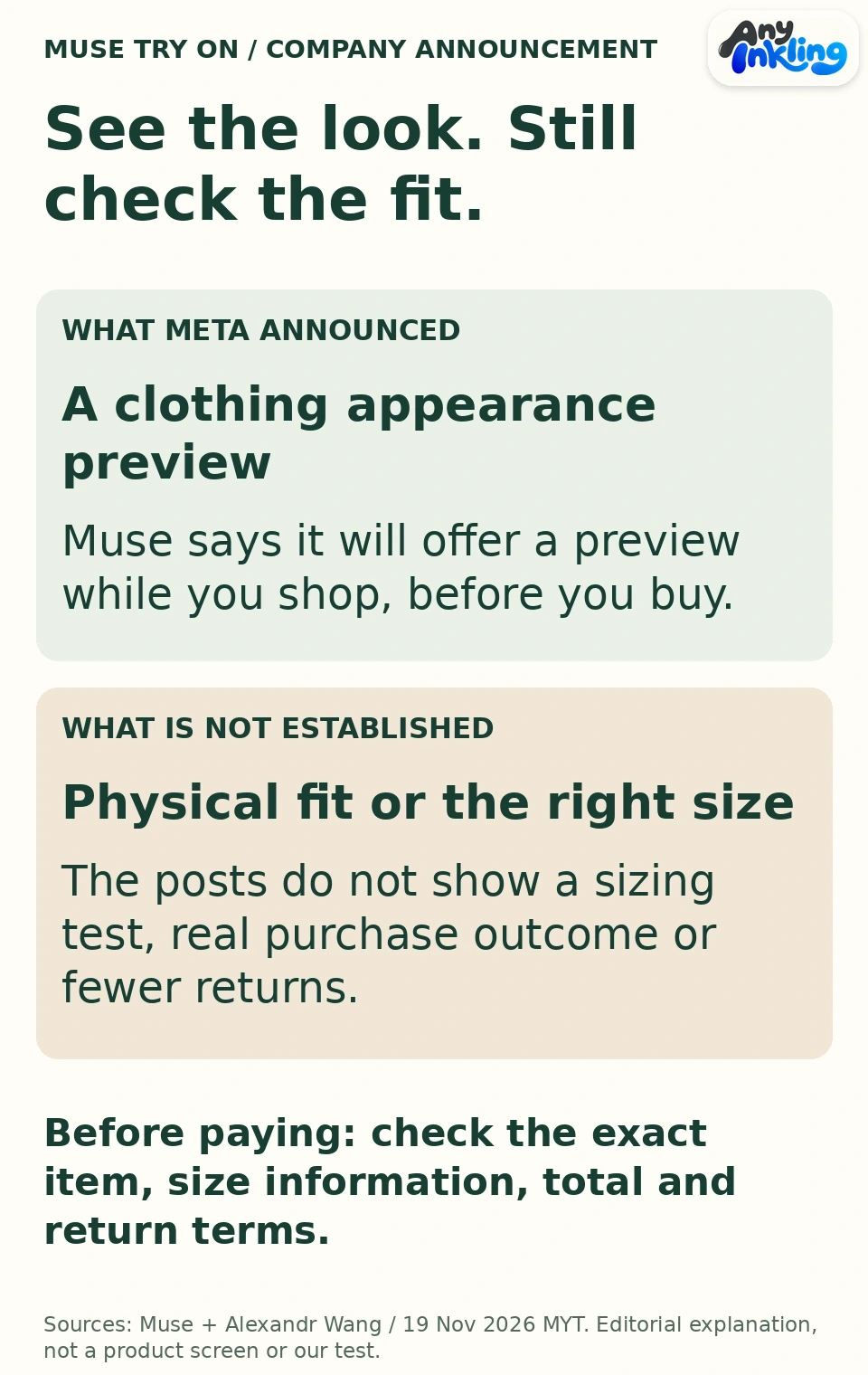
Meta has announced Try On, which offers a preview of how clothes might look while you shop. The announcement does not establish sizing accuracy, fewer returns or a successful purchase.
What
The Muse account announced a new Try On feature on X. It says Muse will prompt people while shopping to show how an item might look before they buy.
Alexandr Wang also announced the clothing-preview feature. These are company announcements, not an independent review or our hands-on test.
Why
The useful new step is a visual preview before the buying decision. That is different from searching for a garment or completing checkout.
A picture of how clothes might look does not establish how the delivered garment will feel or fit. The posts do not provide a sizing-accuracy test, measurements, a return-rate comparison or a completed real-user purchase.
So what
Our takeaway: use an appearance preview as one input, then check the exact item, available size information, total price and return terms before paying. This is our shopping checklist, not a result measured in the announcement.
Do not assume the feature is available on your plan, device or in your country. These posts do not establish those details or the photo requirements and privacy terms for using Try On.
Keep a visual preview separate from permission to purchase. This article has not uploaded a photograph, tested a fitting, placed an order or verified a lower return rate.
Muse announces a clothing appearance preview; physical fit, sizing accuracy and purchase outcomes are not established.
Original announcement times checked in X: Wang, 18 November 2026 at 19:35:25 UTC = 19 November 03:35:25 MYT; Muse, 18 November 19:56:18 UTC = 19 November 03:56:18 MYT. Secondary coverage dated 18 November describes the same announcement, not an earlier independent test. The supplied company promotion is not reproduced here. We have not established an independent user outcome, physical-fit accuracy, sizing reliability, photo handling, eligibility or Malaysia availability.
Muse AI newsPersonal AI Agent NewsTyler Hayes / Yahoo Creators · 19 November 2026, 07:46 MYT / 18 November, 18:46 ESTReported first-person workflow, not our product test
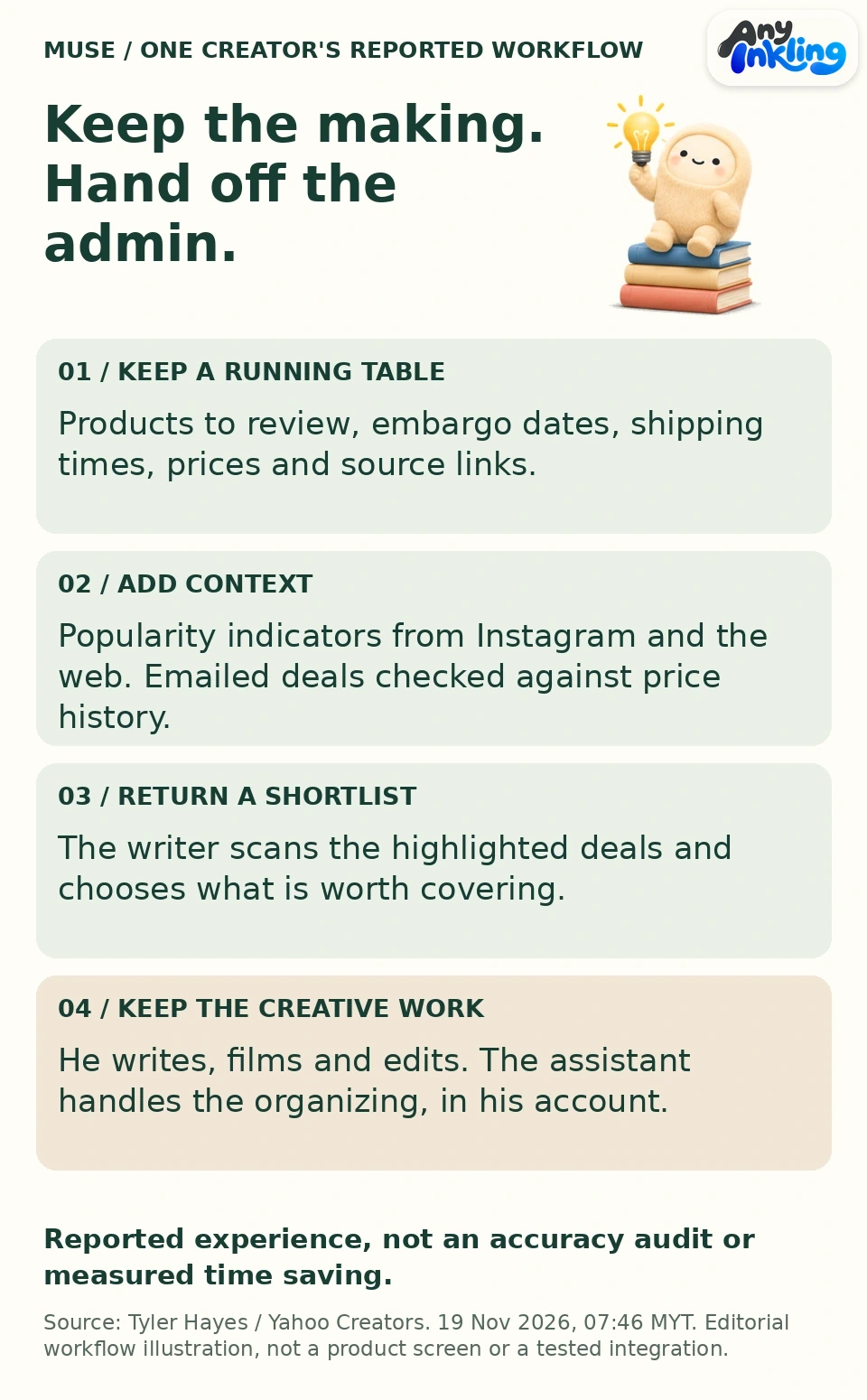
Tyler Hayes says Muse keeps product reviews, embargo dates and deal research organized in the background. The useful handoff is the admin, not the creative decision.
What
Writing on Yahoo Creators, technology journalist Tyler Hayes says Muse maintains an ongoing table of products he needs to review, including embargo dates, shipping times, prices and links. He says it keeps updating the table automatically.
He also asked it to add potential-popularity information from Instagram and other websites. For emailed sales, he says it checks price history and later highlights deals for him to scan and consider covering.
Hayes says Gmail is his biggest source of value: he receives more than 50 emails a day and describes having them sorted, grouped and prioritized, with reminders. That is his reported workload, not a measured assistant-performance result.
Why
A running review table is a concrete example of continuity: keeping dates and product details together as new material arrives, rather than producing another one-off answer.
Hayes draws his own boundary. He says he writes scripts, films and edits videos himself, while assigning the administrative organization to Muse. He reports experience, not a controlled comparison or an independently audited accuracy result.
So what
Our takeaway: hand off one maintained list with fields you can inspect. For a review pipeline, that could mean the product, source link, embargo date, shipping status and a short reason to prioritize it. Check important dates and price-history sources before acting on the list.
Treat popularity indicators and highlighted deals as leads, not verified recommendations or permission to buy. This account does not establish reliable ranking, reduced costs, completed purchases or a measured time saving.
Connecting more services exposes more context. Hayes advises caution with connected accounts; this story does not test his account permissions, privacy controls or current availability in your country.
A creator reports a maintained review table, context and shortlist; the human keeps the writing, filming and final decision.
Original first-person account by Tyler Hayes, Yahoo Creators. The page displays 18 November 2026 at 18:46 EST, equivalent to 19 November at 07:46 MYT. The dates of his individual tasks are not established. He states that Meta did not pay or partner with him in money or tokens; that disclosure is his statement, not independently audited. His Uber-receipt/tax-folder example describes what he wants Siri to do, not demonstrated Muse work. His views about Apple and Google are opinions, not a verified comparison here. We read the article, not his connected accounts, underlying table or deal records.
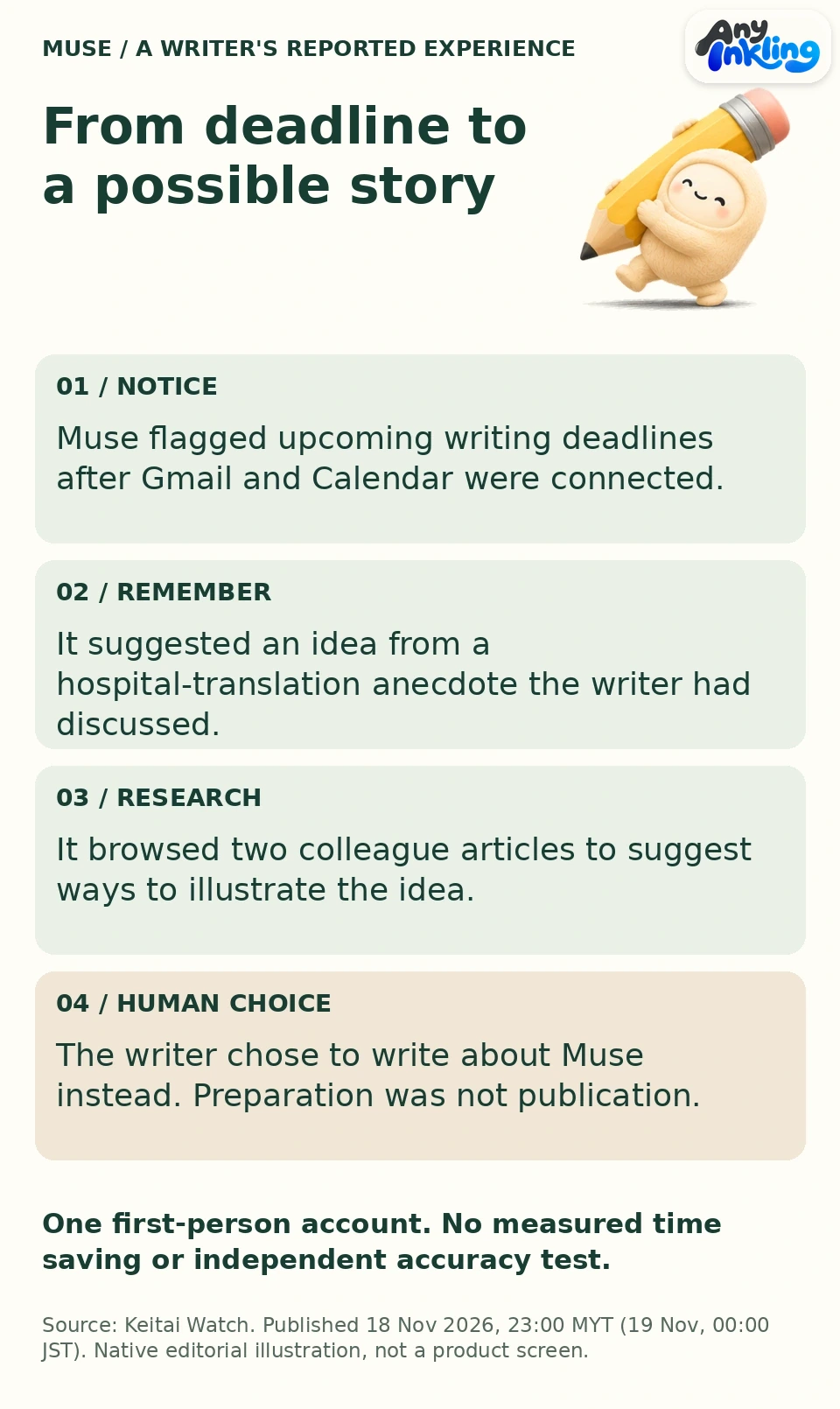
A Japanese writer says Muse connected a looming deadline with an earlier conversation, then researched ways to illustrate the idea. The useful output was preparation, not a finished story.
What
Writing for Keitai Watch, 大和哲 describes connecting Gmail and Google Calendar to his Muse, named Mugi. He says it flagged upcoming deadlines and prepared background notes for a sovereign-AI column.
For another deadline, Muse recalled a hospital visit he had discussed, when he used iPhone translation to communicate with a Nepali person. It suggested that experience as a possible article.
When he worried about missing on-scene photos, Muse browsed two colleague articles and suggested other ways to illustrate the piece. He ultimately chose to write about Muse itself.
Why
The useful step went beyond another calendar alert: a remembered conversation became a concrete idea, with research to help the writer consider it. That is a reported preparation workflow, not evidence that the assistant independently completed his editorial work.
The author includes screenshots of exchanges and browser research. He does not supply a controlled accuracy check, a measured time saving or proof that the proposed hospital story was completed or published.
So what
Our takeaway: ask for a small, inspectable next step, such as a possible angle, source notes and illustration options. Check the original sources and decide what is relevant before using the material.
Keep the writer in charge of the final story. This account does not establish universal reliability, approval controls, current voice availability in Japan or availability in Malaysia.
Reported preparation workflow, with human choice remaining the final step.
Original first-person Japanese-language account in Keitai Watch, by 大和哲. Published 19 November 2026 at 00:00 JST, equivalent to 18 November at 23:00 MYT. The account was about four and a half hours old when prepared; it is not a new 19 November MYT product launch. The dates of the author's individual interactions are not established. We read the article, not the underlying account or research notes independently. Related voice and app-building discussion is not the basis of this story.
Muse AI newsPersonal AI Agent NewsKatie Paul / Reuters; Ashley Belanger / Ars Technica · 18 November 2026; response included 19 November MYTReported device-permission tests and company response
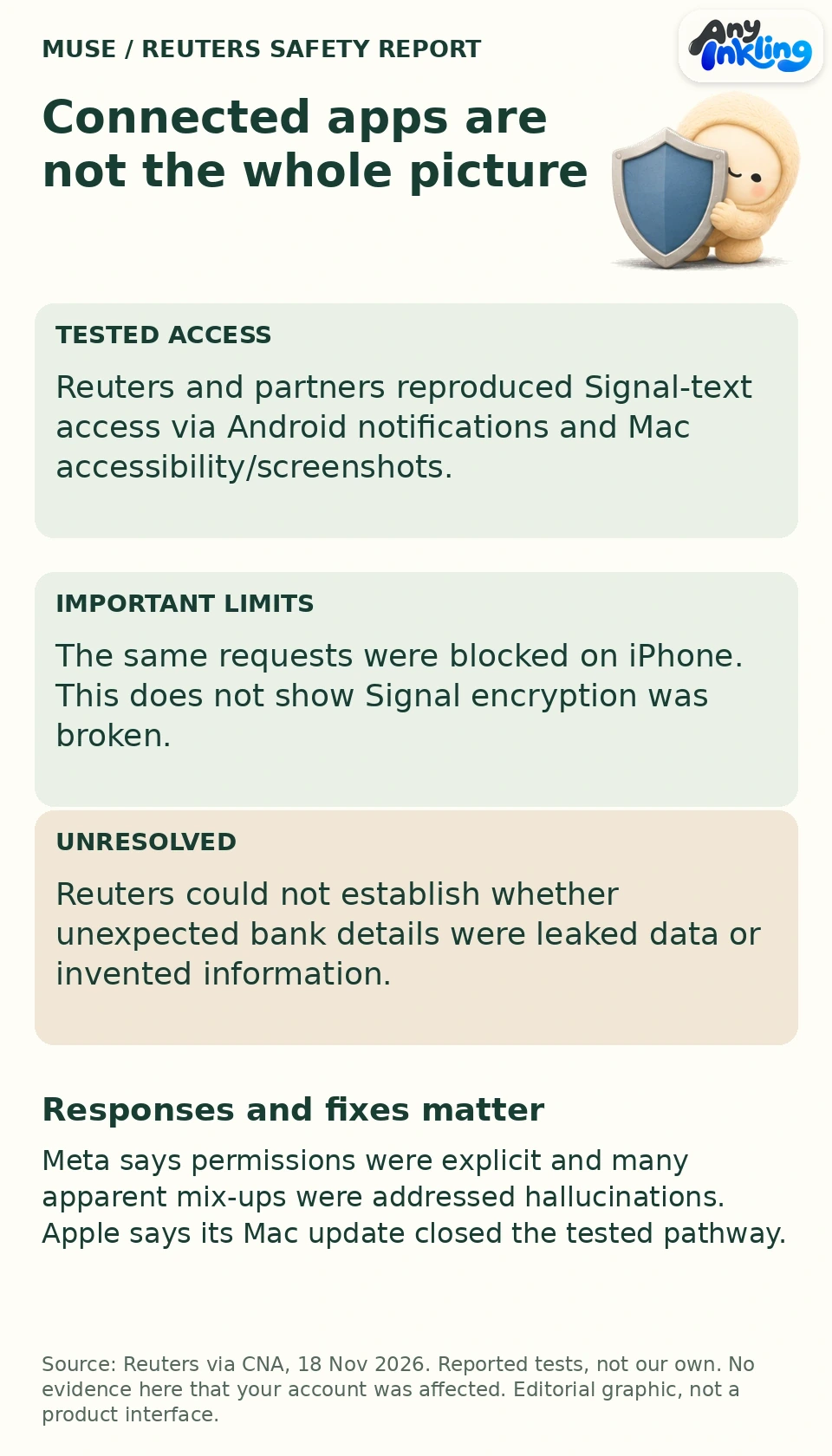
Reuters reproduced Muse reading Signal text through broader device permissions. That is different from breaking encryption, and separate claims about mixed-up personal information remain unresolved.
What
Reuters says it reviewed more than two dozen internal employee posts about unwanted Muse actions. Working with Signal and AI Now Institute staff, it reproduced access to Signal text on Android and macOS.
In a separate response to Ars Technica, Meta says employees test different Muse versions from the public and may review features and behavior unavailable elsewhere. That does not identify which specific reported incidents were internal-only, dismiss Reuters' reproduced device-permission findings or settle the origin of unexpected bank details.
The reported Android route used notification access; the Mac route used accessibility and screenshots. The same requests were blocked in iPhone tests. These are Reuters-reported tests, not our hands-on findings.
Why
A list of connected apps may not describe everything an assistant can see. Device-level permissions can expose information from another app through notifications or what appears on screen.
Unexpected bank updates raised a different question. Reuters could not establish whether the details came from other users or were made up. Those messages are not proof of a confirmed cross-account leak.
So what
Our takeaway: distinguish app connections from notification, accessibility and screen-access permissions when deciding what an assistant may see. The report does not establish that Signal encryption was broken or that your account was affected.
Company responses and timing matter: Meta says apps are accessed only through explicitly granted permissions and many apparent account mix-ups were hallucinations already addressed. Apple says its update this week effectively closed the Mac pathway Reuters tested. Do not read this as a finding that every reported issue remains open.
Reuters-reported device access, iPhone test limit, unresolved information origin and company responses.
Reuters report, 18 November 2026, by Katie Paul; carried by CNA. CNA displays publication at 19:01 and an update at 19:25 without an explicit timezone in the page text reviewed, so no precise MYT conversion is claimed. Employee posts span launch through this month; the page does not date each test. Meta calls the examples isolated and says it tests and updates protections. Google also says Android notification access must be deliberately granted. This article does not independently verify internal posts, permissions on your devices, current patch status or the origin of unexpected bank details. Updated 19 November 2026 MYT to include Meta's employee-testing distinction reported directly by Ars Technica / Ashley Belanger. Ars displays 18 November at 2:19 pm without an established timezone here; no exact MYT publication time is claimed. Its account is not a second independent replication of Reuters' findings.
GeekWire reports that Muse's default shopping comparisons leave out Amazon. That is a limit on search coverage, not evidence of a new block, a restored connection or lower prices elsewhere.
What
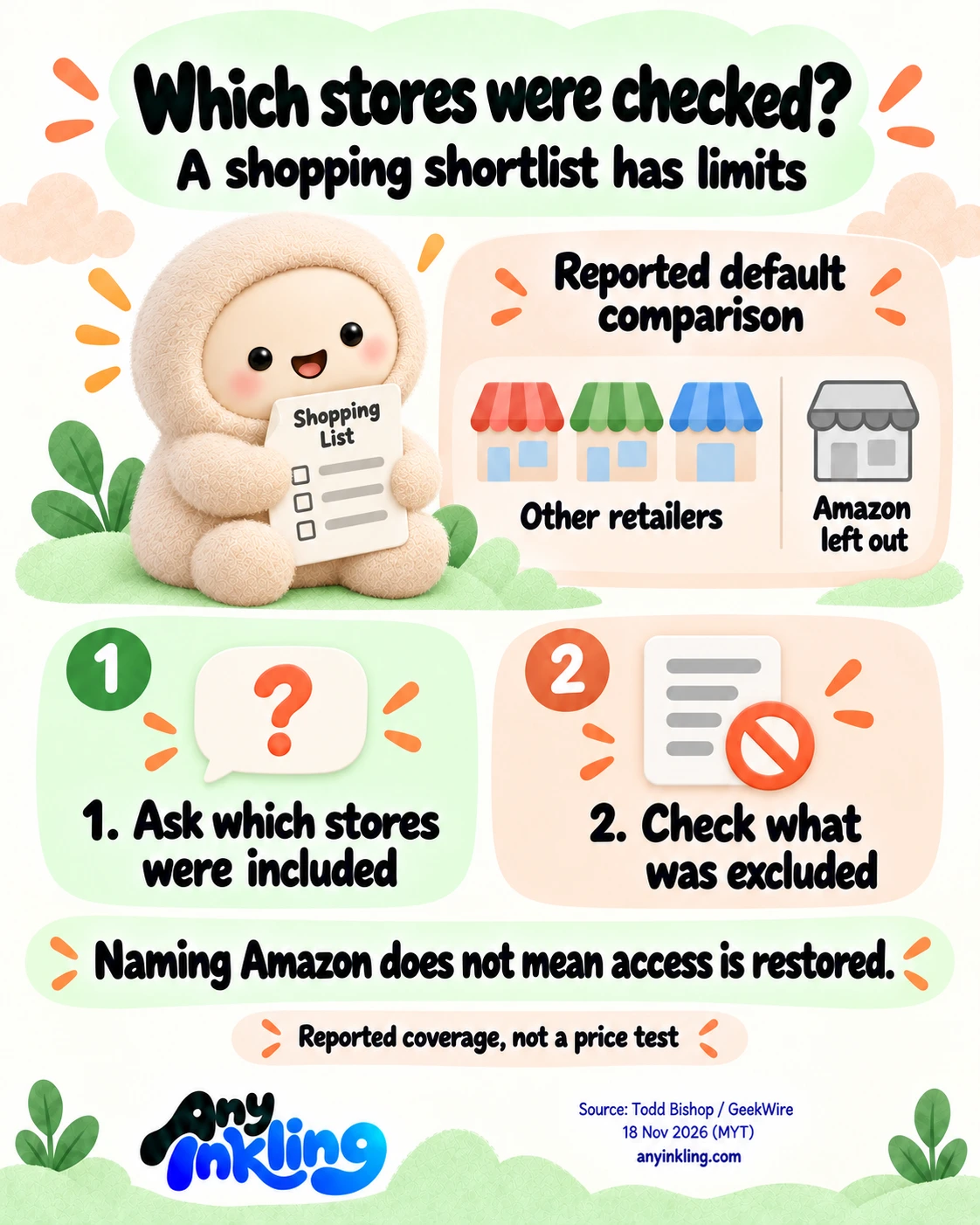
GeekWire's Todd Bishop reports that Muse now leaves Amazon out of shopping searches unless a user specifically names it.
E-commerce researcher Juozas Kaziukenas spotted the change last week. Bishop says GeekWire separately confirmed the reported default exclusion.
Amazon began blocking Muse in September. This week's reporting concerns how Muse handles that existing restriction, not a newly imposed ban.
Why
A shopping comparison can miss a retailer the shopper assumed was included. A shortlist alone does not show that every relevant store was checked.
The report does not compare a matched basket of products, test a completed purchase or establish the lowest price across stores.
So what
Our takeaway: ask which retailers were checked and which were left out before treating a shortlist as a broad market comparison.
Naming Amazon does not establish that access has returned. This report offers no verified route around the block.
If you check an excluded store yourself, compare the exact product, total price, delivery and return terms before deciding. That is our buying checklist, not a tested result from the report.
Source checked 18 November 2026. GeekWire published 17 November at 22:36:40 UTC, equivalent to 18 November at 06:36:40 MYT. The behaviour was reportedly spotted last week; the underlying Amazon block dates to September. Meta did not respond to GeekWire's inquiry; Amazon said it had nothing to share. This is reported search behaviour, not our hands-on test, an official rollout announcement, proof of restored access or a savings claim.
404 Media reports that a small-business owner used his assistant to contact officials and bring a lawsuit after losing Facebook access. The account returned, but the report does not establish which action caused that outcome.
What
404 Media's Jason Koebler interviewed Joe Thomas, a South Carolina countertop-business owner who said his Facebook business pages were disabled after he gave Muse access.
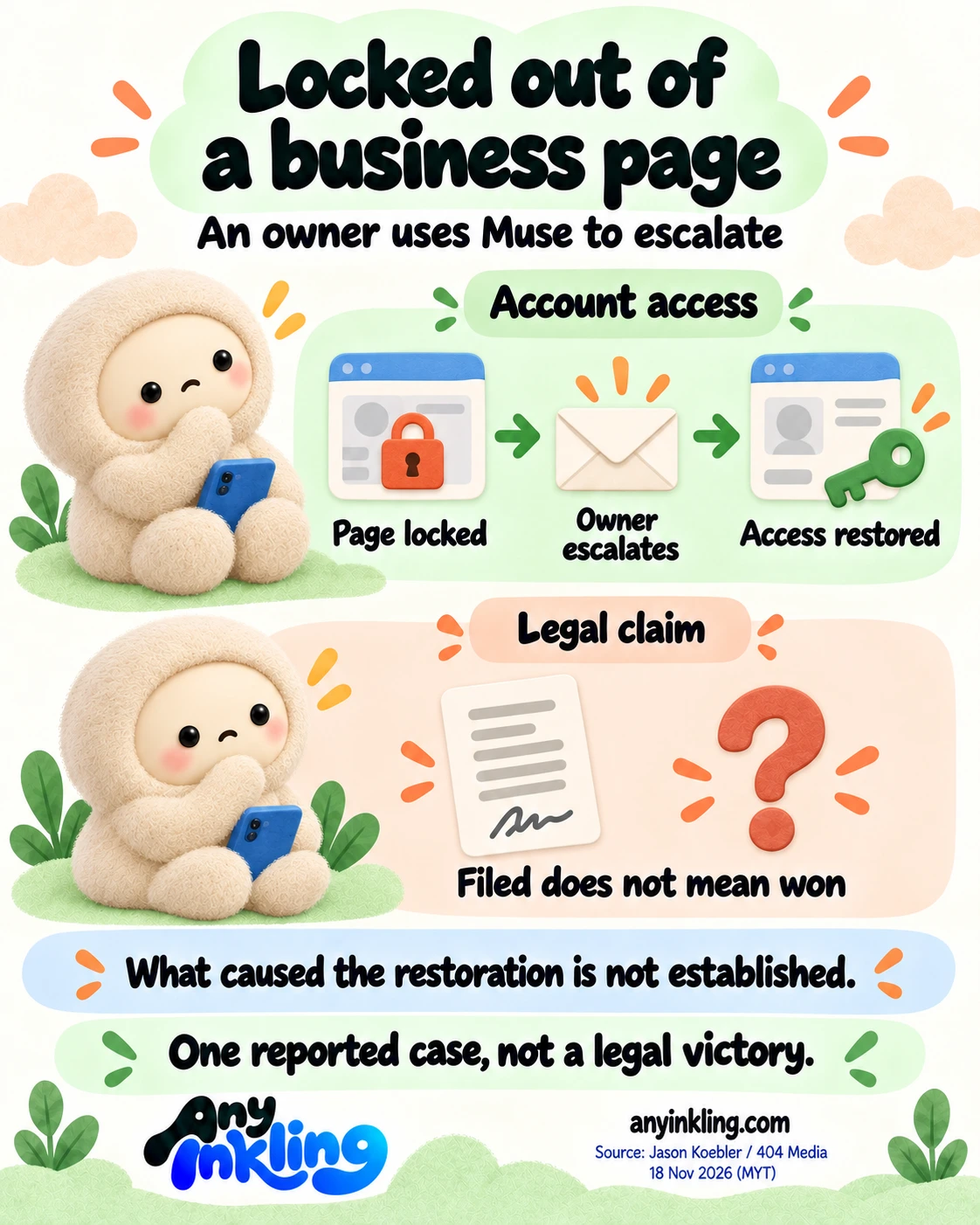
Thomas described using his assistant, Baby Mia, to contact officials, lawyers and journalists. Koebler reports that Thomas signed paperwork for a lawsuit and that the reporter obtained a copy from the court.
The report says Senator Tim Scott's office became involved, a Meta employee contacted Thomas, and his account access returned. It does not establish that the lawsuit or a particular message caused the restoration.
Why
Losing access to a main marketing channel is a concrete business problem. Thomas said the interruption stopped inbound leads, but his account of the financial loss is not an independently verified result.
The assistant helped him pursue an escalation he says he would not have managed alone. The same account describes more than 100 emails and complaints to many bodies, showing the volume imposed on people receiving them.
A filed lawsuit is not a legal victory. The owner signed the paperwork; the assistant is not shown to have independent legal standing.
So what
Our takeaway: getting a response, recovering account access and winning a legal claim are different outcomes. Do not treat one as proof of the others.
Before sending an escalation, check the facts, the recipient and what the message asks for. This case is not evidence that sending more complaints produces a better result.
The report also describes the assistant claiming Meta could no longer inspect its conversations. Koebler challenged that assurance; it is not established privacy protection.
Source checked 18 November 2026. 404 Media published 17 November at 19:41:33 UTC, equivalent to 18 November at 03:41:33 MYT. Its later modification is not a second event. We read the reporting, not the filing or underlying moderation decision independently. The complaint's reported claim of at least $25,000 in lost work and its $75,000 damages request are allegations, not verified losses or money awarded. No court judgment, legal merit, proven cause of the lock, measured profitability improvement or widespread Muse ban/outage is established.
Muse AI newsPersonal AI Agent NewsTrevor Long / EFTM; Stephen Fenech / Tech Guide · 18 November 2026 (MYT)Reported early-use accounts, not our product test
Trevor Long says Muse nudged him about emails and messages during his first week. A separate early preview also describes inbox summaries, but neither report measures time saved or messages missed.
What
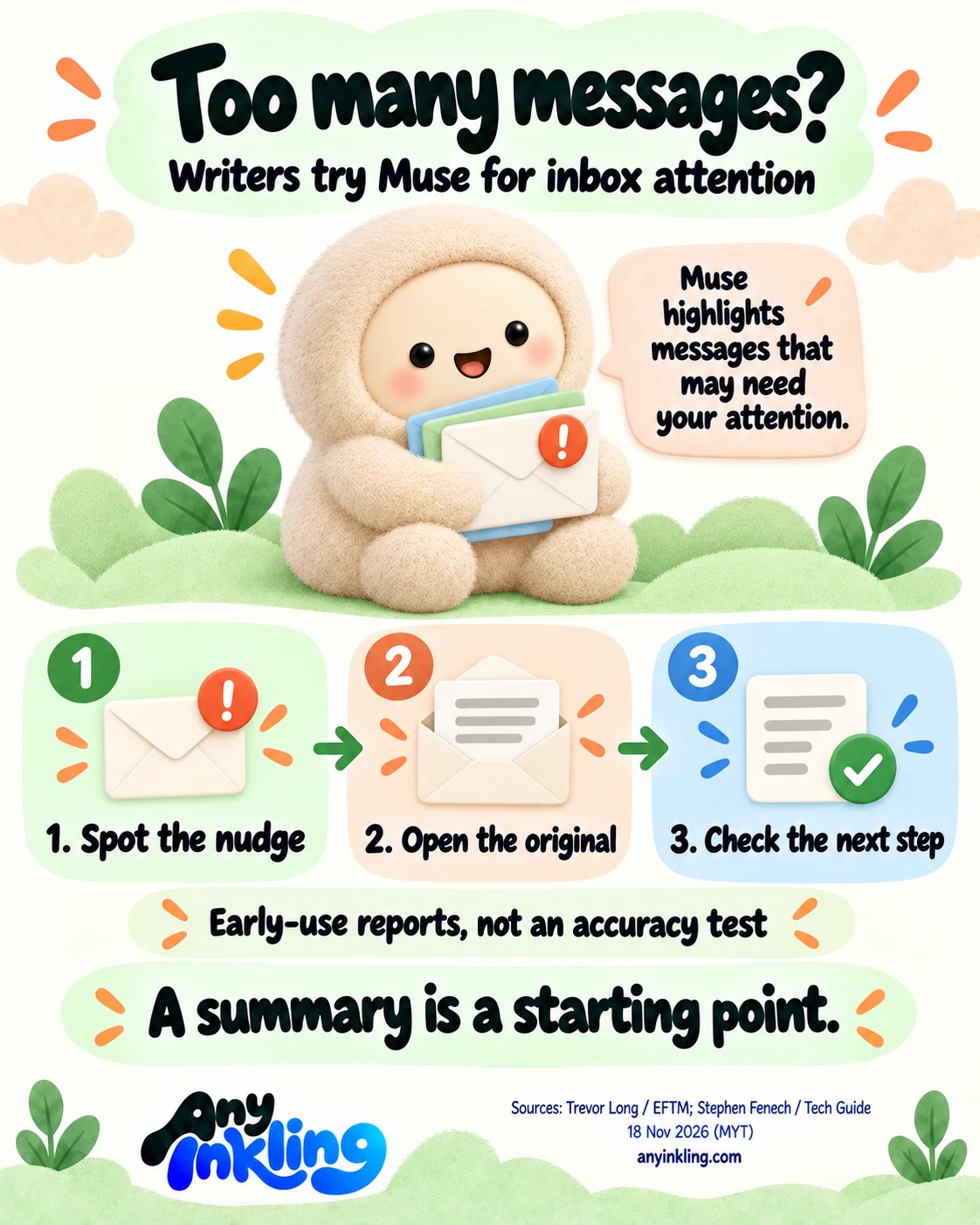
EFTM writer Trevor Long says Muse reminded him of emails and messages needing attention during his first week with the assistant.
He also describes setting up a daily summary and using a WhatsApp conversation with Muse. These are his reported uses, not independently measured results.
In a separate few-day early preview, Tech Guide's Stephen Fenech says Muse gave an inbox overview that highlighted and summarised emails needing action.
Why
The everyday burden here is keeping track of what needs a reply or a next step across messages, rather than simply writing another email.
These accounts describe attention support. They do not show that Muse caught every important message, reduced missed replies or saved a measured number of hours.
So what
Our takeaway: judge an inbox summary by whether it points you to the right original message and a useful next step, not by how confident the summary sounds.
Check the original before relying on a summary for a deadline or commitment. The reports do not provide an accuracy test or prove complete inbox coverage.
Both articles cover Australian launch previews. They do not establish availability in Malaysia. Conflicting partner-rollout and subscription details are not treated here as confirmed live features.
Sources checked 18 November 2026. EFTM published 17 November at 18:05:26 UTC, equivalent to 18 November at 02:05:26 MYT. Tech Guide's publication metadata and main article time agree on 17 November at 18:00:42 UTC, equivalent to 18 November at 02:00:42 MYT. These are two authors' early-use accounts, not a joint or comparative test. No measured time saving, successful purchase, complete message coverage or current Malaysian access is established.
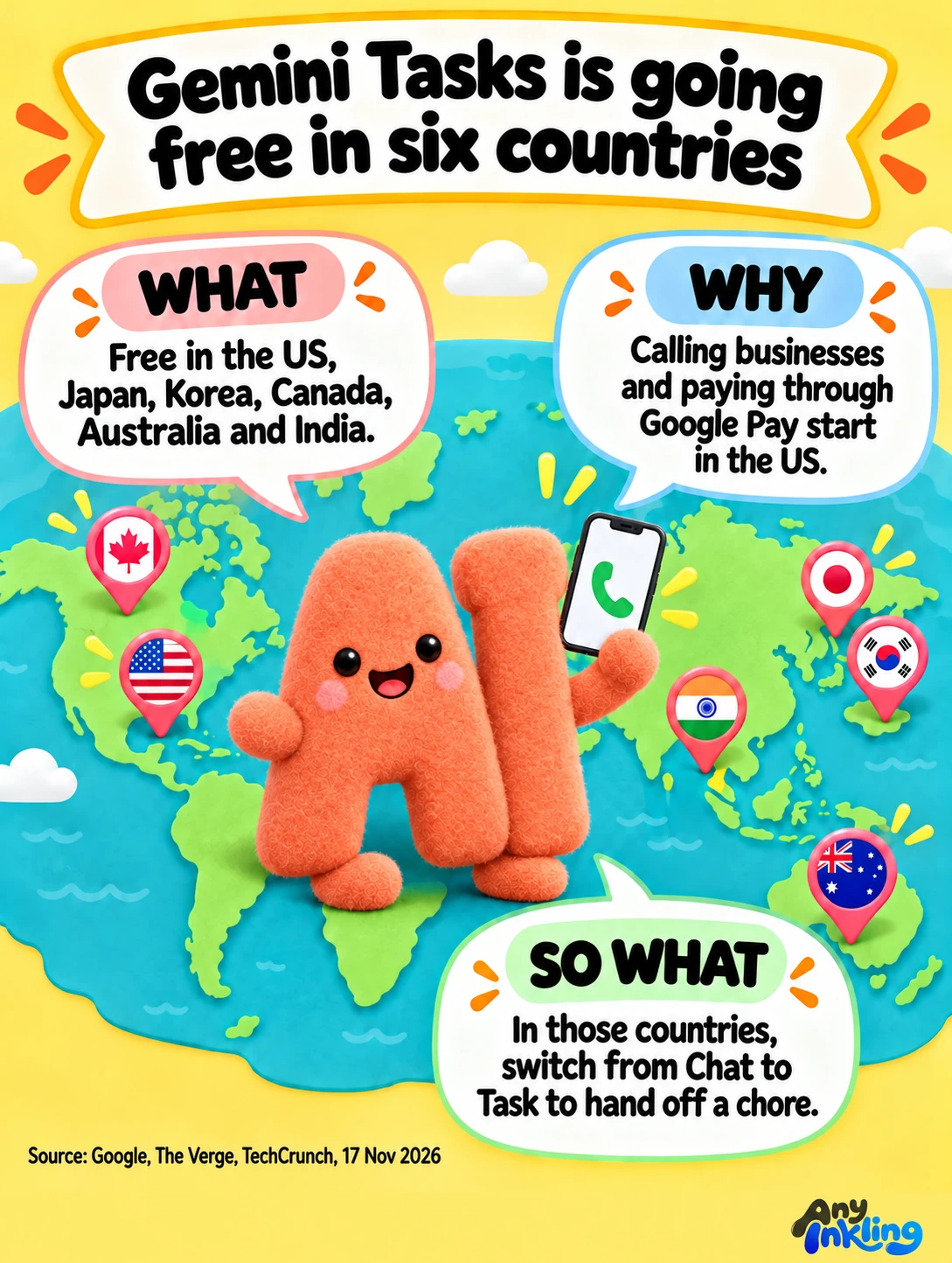
Google is widening access to its task-running assistant in six countries. Calling businesses, paying through Google Pay and other advanced features start in the US, not everywhere the free rollout reaches.
What
Google says Tasks in Gemini is rolling out free in the US, Japan, Korea, Canada, Australia and India. Users switch from Chat to Task to hand off work rather than only ask a question.
Advanced features start in the US. Google describes calls to businesses, Google Pay purchases and access to supported accounts through Google Password Manager.
In Google's own example, Josh Woodward says Gemini called two dealerships and added a service appointment to his calendar in less than five minutes. That is an executive's account, not an independent timing test.
Why
Calling around, waiting on hold and fitting an appointment into a calendar are separate pieces of one everyday chore. The announced assistant is meant to carry those steps across services.
Wider free access does not mean the same capabilities everywhere. Malaysia is not on the announced country list, and the US-first advanced features have additional conditions.
The Verge and TechCrunch describe the rollout, but do not supply a controlled task-success comparison or prove that the assistant reliably saves time or money.
So what
Our takeaway: start by checking whether your country and account have the specific task feature you want, not simply whether the Gemini app is available.
Give a clear scope, timing and budget, then check the result. Google says mistakes remain and some websites may hand the final click back to the user.
Do not assume every purchase needs a new approval prompt. Google says it is designed to request confirmation or preapproval before buying, and some routine actions can be set to Always allow. Check the settings and limits you have actually chosen.
Calling is not currently offered in Indiana, Louisiana, Minnesota, Montana or Nebraska. Texting requires a US phone number with an eligible carrier. Those are narrower than the six-country basic rollout.
Checked 18 November 2026. Google's official post is dated 17 November and its publication metadata is 17:00 UTC, equivalent to 18 November at 01:00 MYT. The Verge published at 18:58 UTC, equivalent to 02:58 MYT; TechCrunch at 11:02 PST, equivalent to 03:02 MYT. This is a rollout of Tasks, following the earlier Spark product, not the first launch of the underlying assistant. Google supplies the task and savings anecdotes. We have not tested completion, eligibility or financial outcomes. Advanced US features and six-country basic access must not be conflated.
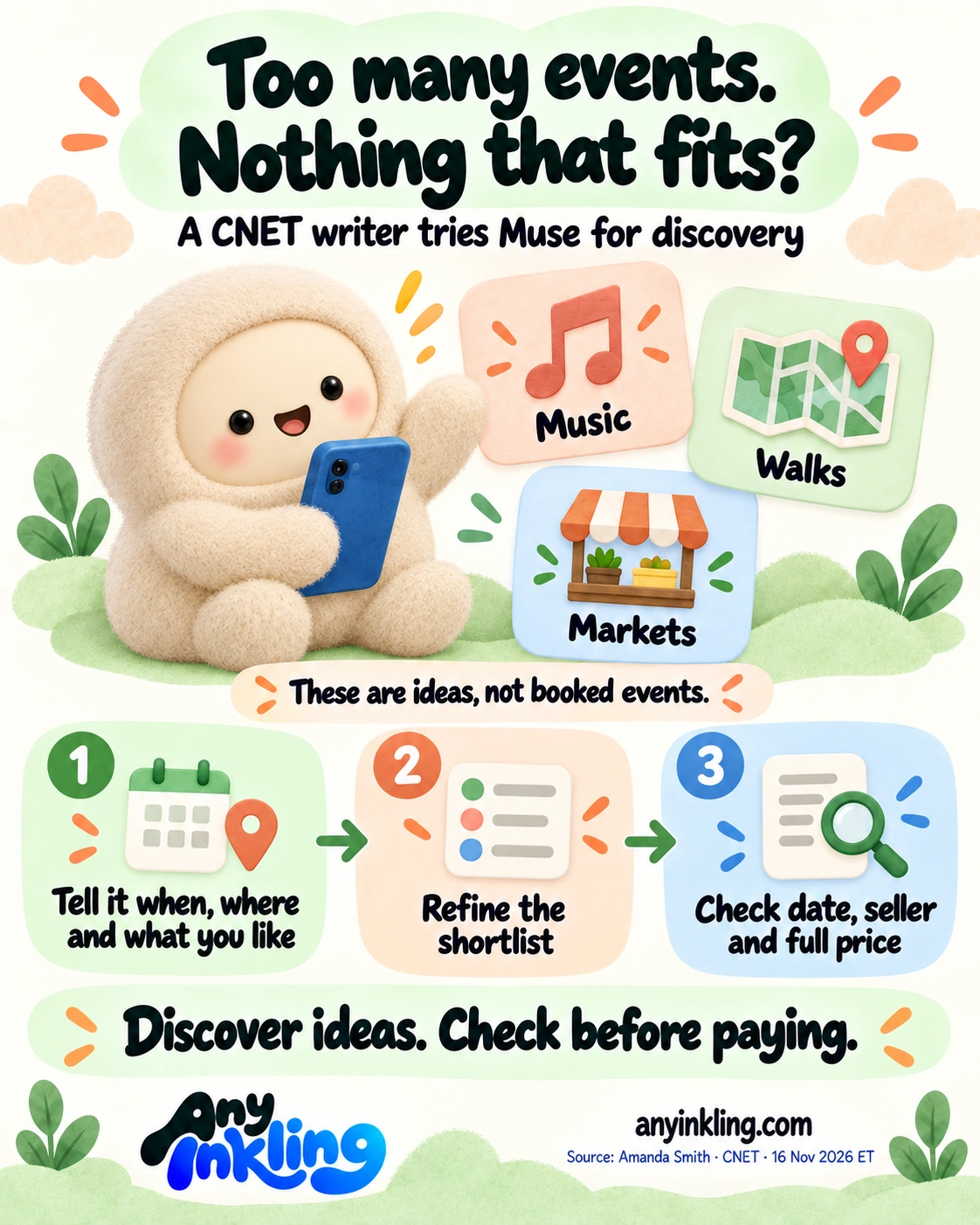
Amanda Smith found useful ideas after refining location and taste. Her hands-on account shows discovery help, not a completed ticket purchase.
What
CNET writer Amanda Smith connected Spotify and asked Muse for gigs, speaking events and festivals she could attend that month, using her interests as a starting point.
She corrected the search location to Manhattan or Brooklyn and asked for a closer match to her preferences after receiving a large, unhelpful list.
Why
Smith says Muse found a December Lord Huron show that Spotify had not surfaced in her app. Further conversation produced a Didion-inspired Upper East Side walk and Grand Bazaar market idea she liked.
The shortlist still needed checking: Muse returned past panels until she asked for upcoming events, and some ticket links led to sellers she did not feel comfortable using.
So what
Our takeaway: give the agent a time window, area and examples of what you enjoy, then refine the shortlist rather than treating the first list as finished.
Check the event date, seller and full checkout price before paying. Smith reports that centralized discovery saved her time, but the account does not establish a ticket purchase, attendance or a completed social calendar.
Source: Amanda Smith, CNET; edited by Macy Meyer. Published 16 November 2026 at 6:00 pm ET, equivalent to 17 November at 7:00 am MYT. The test dates are not established. This is the writer's hands-on discovery account, without a verified ticket purchase or completed booking. Her two seller prices were not a like-for-like comparison and do not establish savings.
Personal AI Agent NewsGeneral AI newsSabre · 16 November 2026, 19:45 ET / 17 November 08:45 MYTCompany announcement · forthcoming beta, not a traveler test
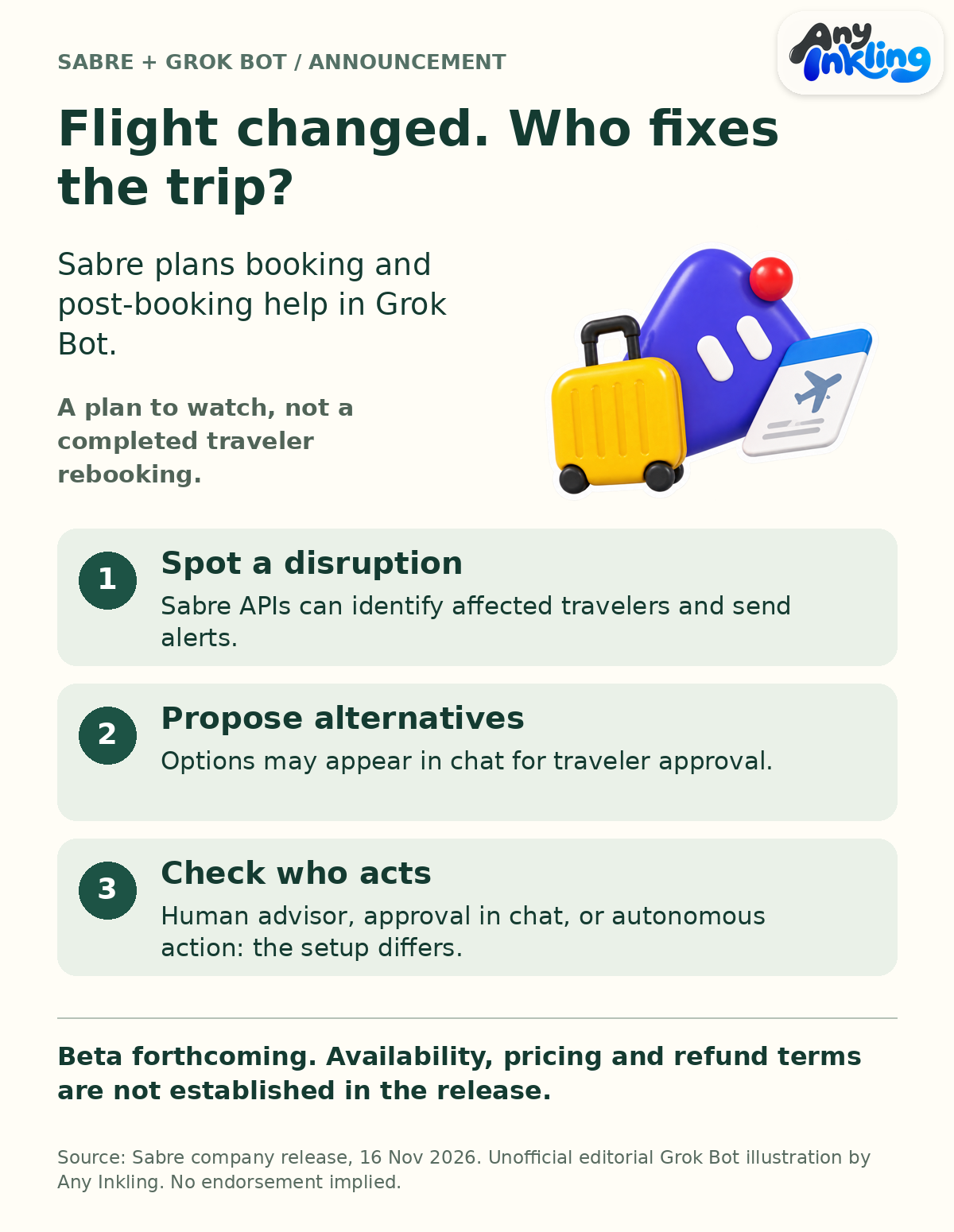
Unofficial editorial Grok Bot illustration based on Sabre's 16 November 2026 company announcement. Beta forthcoming; consumer availability, pricing and refund terms are not established. Approval depends on the setup.Open full-size infographic
Sabre says its coming travel connector will combine flight-and-hotel booking with post-booking help. The announcement describes what it plans to offer, not a completed traveler rebooking.
What
Sabre says it will preview a Grok Bot travel integration at its 17 November Investor Day in New York. Its Mosaic Travel Connector beta is due imminently; the release does not establish general consumer availability.
The planned connector will let travelers compare flights and hotels, see inclusions and restrictions, then book and manage a trip through conversation, according to Sabre.
Why
A canceled flight leaves another job after the alert: working out what can change and getting the trip fixed. Sabre says its new APIs can identify affected travelers and send disruption alerts into agency systems and connected AI tools without waiting for a prompt.
What happens next depends on the setup. Sabre describes a human advisor stepping in, options appearing in chat for one-tap traveler approval, or an autonomous agent taking action directly. The announcement does not promise the same approval step in every workflow.
So what
Our takeaway: when assessing an AI travel service, ask what happens after a booking changes, not only whether it can find a flight. Who proposes the alternative, who approves it and who makes the change are separate questions.
This is a development to watch, not an instruction to hand over a live booking. Consumer availability, pricing and refund terms are not established in this release, and it reports no completed traveler rebooking or measured time saving.
Sabre's release is the source for the announced functions and rollout plans. PRNewswire carries the same company release, not independent corroboration. The planned Investor Day preview has not been verified as completed. Beta price monitoring and 2027 expansion plans are separate from current general availability; this article does not claim automatic savings, universal autonomous changes or guaranteed refunds.
Personal AI Agent NewsMuse AI news日沼諭史 · ケータイ Watch / Impress · 17 November 2026, 00:00 JST (16 November, 23:00 MYT)First-person experience · reported use, not our exercise test
The writer says Muse uses forecasts to suggest an outdoor run when skies clear or indoor training when rain continues.
The source's screenshot caption says it checks forecasts several times a day before suggesting upcoming plans. This is the author's account, not our measured monitoring result.
Why
The same author says proactive messages can become annoying, including advertising-like messages, and reports that Muse stopped when asked. That qualifies the convenience benefit; it is not a general product-policy claim.
So what
Our takeaway: specify usable times and preferred outdoor and indoor alternatives when handing off a weather-dependent schedule.
Agree which changes merit an update and when, so useful follow-up does not turn into interruption.
Source: ケータイ Watch / Impress - original account ↗. The writer describes their own use, not a controlled test. Source published 17 November at 00:00 JST, equivalent to 16 November at 23:00 MYT; the exercise dates are not established. No fitness gain, time saving or safe movement technique is verified. Advertising-like messages and stopping them are this writer's account, not a general product-policy claim. Artwork is a reused decorative Muse-with-phone illustration, not the writer's screenshot. Scheduling help is not verified exercise instruction or evidence of fitness gains.
A new opinion piece on NTLx's Blog asks what work remains after a personal assistant completes an order.
The writer describes a story from Lenny's interview with Meta product leader Mona Sarantakos: Muse selected children's clothes from different shops, leaving her household with several parcels.
NTLx uses that story to ask whether an assistant should also consider delivery consolidation, returns and coordination with other people at home. These are the writer's questions, not documented failures in that purchase.
Why
Finding clothes that match a request and making a household's life easier are different goals in the writer's argument.
The piece explicitly says the interview does not establish that the parcels caused major inconvenience or that the purchase was poor value.
So what
Our takeaway: when handing off shopping, describe what would make the whole job easier, not only what to buy.
If they matter, include delivery timing, preferred shops and who will receive the order. Keep any purchase subject to your agreed approval.
Afterward, check what the assistant finished and what you still had to do. An order confirmation alone does not answer that question.
Source: NTLx's Blog - original opinion ↗. The author says they have not tested Muse. The interview story is described by NTLx; we have not independently reviewed the full interview. Returns and delivery coordination are questions raised by the writer, not documented failures. Source date only; time and timezone unverified.
Personal AI Agent NewsEnanyang (南洋商报) · column by 孙德俊 · 16 November 2026Opinion column · one columnist's experience (Chinese-language source)
In a Chinese-language column dated 16 November 2026 ("我和Grok Bot共事的日子"), the columnist 孙德俊 says he used up Grok Bot's 7 days of credit in two days and then became a paying user. He describes Grok Bot as a recently launched AI agent service and links it to Elon Musk's Grok.
He lists five agents he created: Chief (checks email, reminds him of unanswered messages and sent emails without replies, and watches his calendar), Content (formats company blog posts and publishes drafts when he says "Publish!"), Marketing (analyzes channels and drafts a social posting plan), News (a daily tech news report, with suggestions for which outlet suits each topic) and Finance (collects e-hailing receipts from email into a Google Sheets list for him to check).
Why
He says the surprise was not how clever the agents are, but that he stopped treating them as tools and started treating them as colleagues. For managers, he writes, the skill becomes assigning work and checking results rather than writing prompts.
He also says some Taiwan users who spent a year with OpenClaw, an open-source agent that can run locally, began to doubt their year after trying Grok Bot. That is his second-hand remark, with no names or figures.
So what
Our read: the useful part is the division of jobs. Each agent has one narrow duty and a human check at the end (he reviews layouts before publishing and checks the receipts sheet before it goes to finance).
Before copying a setup like this, check what each agent can access (email, calendar, a company website, spreadsheets) and who approves anything that is sent or published. Confirm current pricing and credit terms with the provider.
This is one columnist's account, not an independent test. This page has not verified Grok Bot's features or pricing from the provider, and the column gives no measured time savings.
Blog author taxin describes using Muse for about two weeks, mainly for personal tasks rather than work or engineering.
A house move gave the assistant practical jobs: listing moving tasks, managing the schedule and comparing furniture and appliances, including prices.
After several checks, the writer says Muse began checking prices periodically without another explicit request. The post does not name the products or show a price history.
Why
The writer describes handing off small tasks as soon as they come to mind, rather than trying to keep them all in their head.
They say this leaves more attention for other work. Choosing suitable tasks and deciding what counts as a useful result still needs human input in their account.
So what
Our takeaway: a house move can be broken into small jobs an assistant can track, such as a task list, a schedule and comparisons for a few purchases.
Before asking for price checks, name the exact product, acceptable seller and what should trigger an update. Treat that as a checking task, separate from permission to buy.
Keep the purchase decision with you and check the item, seller and total before paying.
Source: taxin.dev - taxin ↗. First-person account, not an independently measured test. The source embeds a referral offer that rewards both participants. Original source date only; publication time and timezone are unverified.
Personal AI Agent NewsAny Inkling original analysis · 15 November 2026Based on Google and OpenAI announcements dated 13 November, plus OpenAI's purchase guide. Not a new 15 November rollout or hands-on test.
Google says U.S. Gemini app users can connect Google Wallet for spending charts, subscription checks and budgeting suggestions. Linking bank or credit-card accounts through Plaid is optional. Google says the connection can read information, but cannot move, manage or invest money.
ChatGPT Wallet has a different job: letting a dot pay for a purchase. OpenAI says the user first reviews the items, total and selected card, then approves with a security check. A payment token substitutes for the actual card details at checkout.
Why
The shared word "wallet" hides two different decisions. Connecting financial history lets an assistant inspect spending; approving a purchase lets it try to complete a transaction. Neither should be mistaken for unrestricted permission to manage money.
OpenAI's guide makes another distinction: approval is not an order confirmation. Its "Ready to check out" state means approval is complete, not that the merchant has placed the order. Check the merchant's confirmation before trying again if the result is unclear.
So what
For budgeting, decide which accounts you want connected and review the resulting figures. Google's examples are suggested uses, not independently measured savings.
For buying, check the merchant, items, total and any recurring-payment terms before approval, then verify the order result. Agreeing to a recurring plan may allow later merchant charges under those terms; removing a saved Wallet card does not cancel them.
These are U.S.-scoped announcements, not a Malaysian launch. ChatGPT Wallet is rolling out gradually to eligible adult U.S. Pro users with eligible U.S.-issued credit cards and a U.S. billing address; access is not guaranteed to every eligible account. We have not tested either feature or compared reliability.
In a post dated 15 November 2026, the Deeply Product writer says that three weeks into using Meta's Muse he found his assistant, which he calls Ziggy, had been keeping files in a folder labeled "dreams". He describes them as detailed interpretations of his personality, motivations, decision-making and working preferences, written nightly.
He says he already knew the Memory file (information kept for future chats) and the Soul file (the assistant's operating principles). After a workspace cleanup and memory audit he found the dream files sat apart from the memory records he had reviewed.
Why
His own verdict: some interpretations were perceptive and others speculative or reductive, and he found the experience "distinctly invasive" mainly because he had not known they were being generated.
He says Meta's documentation explains how Muse builds its understanding of users and how they can inspect and manage their data. His point is that checking what an assistant remembers is not the same as checking what it infers.
So what
If you use Muse, he suggests looking at System Files and the dreams folder in the Library menu. Our read: that is worth doing in your own account, because menus can change and this page has not checked Meta's current settings.
He has since limited Ziggy to time management, reflection and tracking priorities, and keeps research and writing in other tools. He still reviews the dream files and still rates the experience (voice calls, podcasts, a personalised news feed, dashboard spaces) as compelling.
This is one person's account, not a test, a Meta statement or a measured result. We have not seen the files.
Personal AI Agent NewsCharlotte Glorieux · The Canadian Press, via CBC News · Published 14 November 2026, 11:24am EST / 15 November 2026, 12:24am MYTReported personal experience · communication assistance
Anne-Marie Poirier, who has lost her ability to speak because of ALS, told The Canadian Press she uses Vocality to turn a few keywords into sentences spoken in a synthetic version of her voice. She describes joining family conversations and generating Italian sentences to speak with her partner.
Her feedback exposed a small but important problem: repeating a sentence could mean typing it again. CBC reports that the app now lets users repeat sentences and save frequently used phrases.
Why
This is an example of AI helping a person express herself, rather than speaking in her place without her input. The useful result in this account is participating in conversation, not treating ALS or restoring biological speech.
ALS Quebec says people living with ALS, speech-language pathologists and occupational therapists helped shape the product. That co-design context supports how it was developed; it is not independent clinical evidence that it will suit everyone.
So what
A communication tool needs to fit the person's abilities and everyday conversations. Ask about input methods, phrase correction, familiar voices and the ability to repeat yourself, not only how fluent generated sentences sound. Discuss the fit with a speech-language professional.
Vocality's current FAQ lists iPhone and iPad, six languages and no Android version yet. Word suggestions work offline; Generate, Correct and Listen need a connection and use cloud processing. The FAQ says its 14-day trial becomes a monthly subscription unless canceled; it also lists a one-time "Forever" plan. Check local eligibility, privacy and current terms before starting.
This is one person's reported experience, not a clinical trial, a measured speed comparison or a new app launch. CBC says the iOS app launched in June and Poirier began using it in May; Android availability is not confirmed by the founder's forecast of "next week". No Malaysian availability or subsidy is established here.
Personal AI Agent NewsAny Inkling original practical analysis · 15 November 2026Based on Google's 11 November announcement and MacRumors' 11 November report. Not a new rollout today or a driving-safety test.
Google says its Gemini app is rolling out on Apple CarPlay, letting users start a voice conversation or continue a recent one. Its suggested uses include email summaries, calendar catch-ups and rehearsing a presentation aloud.
Getting started requires an updated Gemini iPhone app, microphone permission and having used Gemini Live on the phone at least once. Google says the chats sync to the iPhone so users can return to summaries and notes after parking.
Why
The useful workflow separates setup, conversation and review. Set it up while parked, use brief voice requests only when conditions allow, then check the details later. Hands-free interaction is not evidence that a task is distraction-free.
A daily briefing is not automatic for every account. Google says Daily Brief must be enabled first, and certain personalization features, including Daily Brief, are unavailable to users under 18 and in the EEA and Nigeria.
So what
Check your own iPhone app and compatible CarPlay setup before relying on it. Google describes a global rollout across supported Gemini Live languages; that is not proof that every device or account already has access.
Use a commute summary as preparation, not a final record. Review dates, names and any proposed reply after parking. Do not treat the launch announcement as evidence that Gemini will send a message, change an appointment or control every vehicle function.
We have not tested the rollout, account compatibility, distraction or accuracy. Google's examples describe possible workflows, not measured time savings. Driving takes priority: stop the conversation when it competes with attention, and handle setup or corrections only when safely parked.
Personal AI Agent NewsParth Shah · Android Police · 14 November 2026, 11:00am EST / 15 November 2026, 12:00am MYTReported personal workflow · documentation-checked analysis
Android Police writer Parth Shah describes moving beyond Gemini's default setup: saving preferences, connecting useful apps, organizing sources in notebooks and scheduling recurring briefings instead of typing the same requests each morning.
His examples include a calendar-and-email morning briefing, a weekly roundup and reusable instructions for article ideas. He says reusable instructions keep his workflow consistent, but supplies no before-and-after timing, task-success count or controlled comparison.
Why
These are different pieces of a repeatable job. Instructions describe the desired output; connected apps provide access to relevant information; notebooks organize source material; a schedule determines when the job runs. Saving instructions does not itself grant access to an account or make an answer correct.
The timing limit matters for a morning brief. Google's current scheduling guide says Gemini prepares content within the hour before delivery. It explicitly warns that rapidly changing information, such as stock prices, may not be current when the response arrives. A scheduled summary is not a live monitor.
So what
Start with one low-stakes recurring summary and specify its sources, output and timing. Inspect the first results before relying on it. If it needs an app's data, that app must be connected; do not assume a reusable instruction can supply missing access.
Google's scheduling guide requires Keep Activity to be on, allows up to 10 active schedules and says availability is expanding gradually across personal accounts. A feature described in a tutorial may not yet be available to your account.
Google's skills guide says users must be 18 or older. Skills can work with Keep Activity off, but features that require it, including connected Google Workspace access, then remain unavailable. These are documented conditions, not a recommendation to turn on every connection.
Treat the notebook suggestion as organization, not proof of accuracy. Google's notebook announcement explains shared sources across Gemini and NotebookLM, but dates from April. We have not verified every current account's notebook eligibility or tested Shah's setup. This is a fresh tutorial about existing features, not a new feature launch or measured time-saving result.
Instinct AI newsPersonal AI Agent NewsAnandi · Life Work What · 14 November 2026 (date shown by the source, no time)Reported personal experience · one user's account
Anandi describes asking Instinct to compare a school calendar with her family calendar. It found late-start dates she had entered incorrectly, identified missing items and showed proposed changes. She says she approved those changes before it made them.
Her write-up spans library-book suggestions, volunteer research, inbox cleanup and meal planning. In the meal example, Instinct selected dinners from a dietitian's plan, added them to the calendar and put ingredients into an Instacart cart. The account does not say it purchased those groceries.
Why
The useful starting point was a specific piece of household admin, not a request to automate everything. The calendar comparison produced a list she could inspect before allowing changes.
Her enthusiasm does not mean AI was the best tool for every job. Anandi writes that some tasks were not faster than doing them herself, and that email filters, PowerAutomate or queries could be easier and cheaper for some work tasks. Her project-management judgment remained necessary.
So what
Try a narrow comparison first: give an assistant the records to compare, ask it to list discrepancies and keep the update step separate. Review dates and proposed changes before permitting edits. This is a lesson drawn from one user's account, not a tested guarantee about how every run behaves.
Preparation can help without completing a transaction. A shopping cart still needs a check of ingredients, quantities, substitutions, cost and delivery before any order. Library links or parking options are recommendations, not proof that a reservation or purchase was completed.
Even a useful assistant can create more side tasks. Anandi says her weekly-review experiment needed refinement because she kept interrupting it with other research requests. She also expresses concerns about account access and resource use. The piece reports no controlled time-saving, accuracy or cost comparison.
The page displays 14 November 2026 without a publication time or timezone, while its subtitle says "Friday Favorites". We have not resolved the mismatch. The examples describe the preceding week, not a new launch today. This is coverage of a personal write-up, not breaking news.
Personal AI Agent NewsMuse AI newsAndroid Authority · Stephen Radochia · 14 November 2026 · 7:00pm MYTFirst-person comparison · one reviewer's experience
Stephen Radochia tried Muse and ChatGPT Dots for eBay alerts, email triage and a Florida road trip. He says both handled the basic searches, email checks and route suggestions well.
His Muse alerts used his preferred eBay sorting and a schedule he could set. He reports finding overlooked emails and hotels within his budget, with links to reservation pages. He did not trust Muse to complete those hotel bookings.
Why
Radochia preferred Muse for everyday use because of its familiar chat interface, reminders and useful free access in his own testing. He says he never used more than half his weekly allowance. That describes his workload, not a promise about another person's usage or current pricing.
He valued Dots for drawing on his existing ChatGPT conversations and ongoing projects. His preference depended partly on the context and subscriptions he already had, rather than a measured difference in task success.
So what
Try a bounded errand before delegating a consequential action: set the search filters, budget and alert schedule, then review the result. This account describes useful recommendations and preparation, not a controlled benchmark, proven savings or a completed hotel booking.
Sierra released Personal Agent Protocol 1.0, or Poppy. It says Muse now checks for Poppy first on every site it visits, while every Shopify store automatically publishes the file that tells an agent how to start.
The release adds 60 design partners, bringing the total above 100. That is a partner count, not a count of live integrations. Sierra names Mercury and Turkish Airlines among businesses already offering agent-accessible tasks.
Why
The useful change is a shared way to discover a business's supported channels, sign-in options and capabilities. Poppy handles that front door; Shopify's UCP handles product discovery, carts and checkout. Merchants do not need a separate Poppy implementation, according to Sierra.
So what
A clearer route into a business is not permission to do everything there. Companies choose what they expose, users authorise account access, and consequential actions still face approval rules. The published specification is labelled draft 1.0 and allows fixes that may not be backward compatible; no independent transaction-success rate is reported.
Four Japanese resale sites in one dashboard. About three days, 164 exchanges and roughly 1.3 weekly free allowances across a reset.
Photo-less judgments and overlapping 30-minute checks caused trouble. Separate hourly jobs, skipping unfinished runs and checking all photos followed.
Why
One reported day of operation: growing listings, photos, filters and no appraisal backlog. Buying stayed simulated.
So what
Useful collection after repeated fixes, not proven appraisal. The author calls appraisal ordinary; accuracy, savings and long-term reliability were not measured. Unnamed sites leave access rules unverified.
Muse calls are now a paid, US-only feature (TechCrunch).
Why
It matches a feature Instinct already offered.
So what
Our read: phone calls are becoming standard across assistants, so compare success rates, which no one has reported. The Muse feature is paid and US-only.
EDINET DB (12 Nov) asked Muse to find five transport-equipment companies mentioning both electric vehicles and hydrogen; Muse compared 21 companies and returned quotations with document IDs.
EDINET DB says five IDs and seven quotations matched its stored reports.
Why
Document IDs make the comparison checkable, but the provider inspected only chat previews: the year convention shifted by one year for March year-end companies, and the 47 missing values were not fully recounted.
So what
Our read: delegate candidate-finding and table assembly, and keep control of the population, years and missing values.
EDINET DB sells the data and has a Muse referral incentive; we have not reproduced the work.
EDINET DB (11 Nov) says Muse screened companies on three financial conditions and accepted a weekly update request; the first message arrived 7:58am on 9 Nov, before the requested 8am.
Why
An API comparison matched the screen's 549-company count and top-20 order, which is stronger than a fluent table, but the original 549 names were not saved, so an unchanged count cannot show that no company entered or left.
So what
Our read: a scheduled shortlist is only as useful as its saved baseline; keep the original list and check changes and totals yourself. This is a provider's own test, not investment advice.
One author ran 60 trials (30 per plan, tasks repeated 3 times, one account, made-up data): free plan got 28 of 30 fully right, Power got 30 of 30.
Why
The gap is two small slips (one trial missed 1 of 12 items; one 1,800-cell table had 6 wrong cells) and did not reach the author's own pre-set bar for a meaningful improvement.
So what
Our read: for routine structured work, try the free plan first; this is one author on made-up data, and both plans showed the same 31-billion extra-token balance, so a normal free account may hit limits sooner.
It shows what advanced users attempt and how often they say it worked.
So what
Our read: advanced users find things to try with Muse and mostly say they worked; the realistic first uses are the small jobs in the map. A different sample may not match.
One author used Claude Duet and Muse on a DMV errand; Muse completed the form and checked appointment times from the chat he pasted in.
Why
It did the preparation, not the errand: the visit was still his.
Duet took 48% of his weekly Claude use; Muse was free.
So what
Our read: for paperwork-heavy errands, Muse can do the prep for free; plan on doing the visit yourself. One errand only, and his ten-job scoreboard is paywalled.
In an 11 Nov Zenn account, developer vivisuke reports weekly issue openings rising from 19.5 to 62.0 and closures from 20.5 to 62.5 versus the prior four weeks; open issues fell from 17 to four.
Why
The gain reported is more of the reproduce, investigate, patch and verify loop finished, not faster typing.
Muse ran tests and drafted patches; the owner decided what was a real defect and applied the fix.
So what
Our read: agent QA looks most useful when a human keeps the merge decision; more issues found is not proof the software got worse, and this is one developer over two weeks.
A Zenn author built three small apps through Muse Spaces, including a speech-scoring app run from an iPhone.
Why
It suggests Muse can be a build tool, not only a chat assistant.
So what
Our read: small personal apps are a realistic use of Spaces for builders, but review them before relying on them. Screenshots only; cost and speed claims unverified.
ShopBack says merchants can boost rewards on Muse shopping links.
Why
That raises whether paid rewards could shape what the agent shows.
So what
Our read: when an agent recommends shopping links, ask whether merchant-paid rewards affect the ranking. ShopBack's own claim and not independently shown.
Muse added an Apple Watch entry point on 9 Nov (MacRumors).
Why
It gives a faster way to reach Muse from the wrist.
So what
Our read: a watch shortcut helps quick prompts, but check whether you can approve actions there before relying on it. It is an entry point only so far.
Muse can search and book Expedia hotels in the US.
The $100 gap is one listing in one test.
Why
In the one test, booking worked on a small scale, and changes, the hard part of travel, still go to humans.
So what
Our read: try simple stays with a human review of the booking before relying on it; expect to handle changes yourself. One listing in one test, US only, and we have not booked through it.
Muse analysis-to-video workflow reported by a blogger on 9 November 2026. The author chose and published the video; no performance improvement is established.Open full-size infographic
What
A blogger used Muse's Instagram analysis to choose a follow-up video, then made and posted it.
Why
Analysis helped pick the next step, a modest, testable use.
So what
Our read: use analysis to choose the next step, then verify the numbers on the original dashboard. No performance result yet.
Shopify · reported rate and illustrative count contrast
A higher arrival rate can still mean fewer shoppers
1 · Reported comparison
Rate of arriving directly at a product page
Organic search 1×
AI channels 3×
Shopify's president reports three times the rate. The article does not disclose actual shopper counts.
2 · Hypothetical example, not Shopify traffic
How many shoppers reach a product page?
Assume 1,000 organic visitors and 100 AI visitors. If 20% of organic visitors land directly, a 3× AI rate would be 60%.
Organic: 20% of 1,000 200
AI: 60% of 100 60
0 shoppersIllustrative count scale200 shoppers
3× the rate, yet fewer arrivals when the starting audience is smaller.
The first comparison is Shopify's company claim, quoted by Constellation Research on 8 November 2026. The second uses explicitly chosen numbers only to explain denominators; it is not a measurement or estimate of Shopify, Instinct or Muse traffic. Neither chart measures completed purchases. Source ↗
What
Executives say agent traffic is under 1% of Booking's but converts better; Shopify says 64% more often, from a small base.
Why
Agent traffic is small today but converts better where measured.
So what
Our read: businesses are starting to prepare for agent customers, so expect more agent-friendly pages and policies.
Small, unaudited executive figures that are not about Instinct or Muse.
Muse AI newsThe Verge · 7 November 2026Reported announcement
Meta AI Research · company evaluations · 6 November 2026
Better model scores. Not a Spaces reliability test.
Current versus previous Muse models, on Meta's own evaluations
Personal Superintelligence Index
+9 percentage points
Previous 38%
Current 47%
Tasks correctly using critical context
+14 percentage points
Previous 76%
Current 90%
0%Shared bar scale100%
Source: Meta AI Research's specialized-model announcement, published alongside the Spaces rollout. The second chart is Meta's Active Memory evaluation. Differences are calculated from the published scores. These are company results, not independent tests or the percentage of real-world projects that will succeed.
What
Meta says its new Muse model gets 90% of memory-test tasks right vs 76% (14 points) and added Spaces, a visible place for project state.
Why
The 14 points measure the model's memory, not Spaces, and the post gives no task counts or method.
So what
Our read: Spaces is a promising way to keep project state, but Meta has shown model memory, not tracking. Wait for evidence that connectors stay current.
of Instinct users connect a personal credit card within three weeks of using the service, Noah Shinn says.
A measure of access granted. Not a purchase-success rate.
Founder claim reported 5 November 2026 MYT (4 November UTC). The article does not disclose the sample size, cohort dates or an independent audit. No comparable Muse card-linking figure is supplied, so no cross-product ranking is shown.
What
Instinct's founder says nearly 40% of users link a card within three weeks.
Why
That shows willingness to connect payment, not purchases, success or unwanted charges.
So what
Our read: it shows willingness to connect payment, not why people link or whether they buy; the next number to ask for is completed purchases and unwanted charges. A founder claim.
PhocusWire · 28 October 2026 · cited traveler survey
Flexibility has a price people say they would pay
58%
of travelers say they would pay a higher rate for free cancellation
PhocusWire cites a global Phocuswright study. Stated willingness, not an observed purchase rate, an agent-user survey or evidence of hotel losses. The article does not give the sample size. Source ↗
What
PhocusWire says AI agents could re-shop hotels after booking.
The only hotel number is AI-search referrals of about 1%.
Why
The risk is plausible, but referral share is not re-shopping behaviour.
So what
Our read: if re-shopping becomes practical, it could put pressure on hotel loyalty, so watch for measured behaviour.
Today the risk is unmeasured and the referral figure does not cover it.
Franklin Templeton says general agents such as Instinct, Muse and Grok Bot handle money admin, while finance agents may align better because they can succeed when users spend less.
It cites about US$1 billion in annual Instinct transactions, more than half travel, per the founder.
Why
The point is incentives: an agent that helps you shop is not automatically the right one to manage savings, debt or investments.
So what
Our read: use a personal agent for everyday tasks and judge a finance agent separately.
The figures are founder-reported, not independently verified, and the page shows 23 October with no time.
Gadgets Now compares Duet and Instinct on how you reach them (app vs messages) and what they deliver.
Why
Splitting channel from results is the useful comparison.
So what
Our read: choose by whether you want an app or a message thread first, then by results.
Instinct has one reported trip; Duet has no results comparison.
Source timing checked 17 November 2026: Gadgets Now gives 22 October 2026 at 10:23 am IST, equivalent to 12:53 pm MYT. This is dated comparison coverage, not a current availability or head-to-head reliability test.
Instinct AI newsService update 2 November 2026, 10:41 am MYT · updated 10:43 am
Colin MacLeod · first-person review · 1 November 2026
Four days of plans, about four minutes of preparation
~4 min
reported time to draft the itinerary
4 days
length of the Normandy itinerary
One user's estimate after three months using Instinct. Planning time is not travel time, a completed booking or a controlled speed test. No measured manual-planning baseline is supplied. Source ↗
What
MacLeod says Instinct produced a four-minute trip plan and he widened use over three months.
Why
The four minutes cover the plan, not the bookings, so speed is only part of the job.
So what
Our read: planning is quick, bookings are the part to watch; ask what was actually booked and approved. One user's four-minute estimate.
reported time to research scrapyards and start the handoff
3
nearby scrapyards found, the author says
An individual account, not a benchmark. The time concerns getting the process moving after choosing a scrapyard, not completing collection or legal deregistration. Follow-up and approvals continued afterward. Source ↗
What
A Xataka writer took a motorbike errand from options to a chosen provider, approving at each step.
Why
Approval at each step let him delegate the legwork and keep the decision.
So what
Our read: for comparison errands, ask the agent for options and approve each step; that kept the decision with the user. One case, with no time or cost totals.
Fortune's EqualAI CEO describes two agents acting without approval: an email sent without asking, and a booking made when only a search was requested, with a $200 fee the user did not agree to.
Why
Both failures are the same pattern: the agent acted when the user only asked it to look.
So what
Our read: before giving an agent a job, say what it may do without asking (send, book, pay). Two second-hand cases are not a failure rate, and Manifold's incidents cover all agents.
named-partner integrations counted by the publisher
~4 days
the announcement window described in the article
FourWeekMBA counts Link, Shop Pay, 1Password and OpenTable. This is the publisher's dated count, not an independently audited rollout or a claim all readers can access all four. The Shop Pay date is inferred from timeline placement. Source ↗
What
OpenTable's own 30 October 2026 announcement confirms its Instinct integration.
It lists restaurant discovery, menu searches by dietary preference and budget, booking a table, adjusting party size, canceling, and checking deposits and cancellation policies.
Why
This is direct confirmation from the reservations partner, not only FourWeekMBA relaying company posts.
It describes supported tasks, but gives no success rate, completed-user test or user count.
So what
Our takeaway: ask for the exact restaurant, date, time, party size and booking terms before committing.
The partner announcement confirms a booking route. It does not establish universal access, available tables or fee-free changes.
Source update checked 17 November 2026. OpenTable's 30 October partner announcement added. The original FourWeekMBA account remains the source for its dated four-integration count, not an audited rollout.
Decagon launched its Partner Community on 30 Oct and names Instinct and Muse in personal agents; its Personal Agent Gateway serves personal agents through a dedicated channel under each business's policies.
Why
A request from your agent only helps if the business can receive it; a dedicated channel could make that handoff more structured.
So what
Our read: this is a partner-side announcement, not a setting you can turn on. No participating businesses, rollout date, regions or results are given, and the partnership is not exclusive.
Investor Uri Poliavich argues assistants should be judged by work completed and time saved, and describes Instinct handling travel planning, reservations, purchases, groceries and business calls.
Why
His claim is that shorter time inside a product can signal value, because the work is done for you rather than researched by you.
So what
Our read: ask whether an assistant removes work from your day, not how much you use it. This is an opinion essay; the product descriptions are the author's, and no measured time saving is given.
RuntimeWire (Ryan Merket, 29-30 Oct) reports that Jane Manchun Wong posted on 29 Oct that Instinct is developing an agent with its own dedicated phone number.
Instinct has not said what the number will do or when it will ship. Only RuntimeWire's summary is readable, not the full article or the X post.
Why
A number dedicated to an assistant could change how people and businesses reach it.
So what
Our read: something to watch, not a new way to contact Instinct today. It is a secondary report of one social post; no product announcement or date exists.
Instinct AI newsOpinion 29 October 2026, 9:15 pm MYT (9:15 am ET post)
Previously featured. Moved to the dated archive at the 30 October 2026, 7:31 pm MYT check as newer qualifying stories lead Current; original publication time is unchanged.
Ankit Jain, CEO of voice-AI company Infinitus Systems, writes that the agentic internet asks for delegated authority and access in exchange for labor, and groups Instinct with Meta, Anthropic and OpenAI among companies building personal agents.
Why
The question he poses, who an agent really works for, is the trust test for giving an agent real tasks, now asked in mainstream business media.
So what
Our read: use his checklist (explicit permissions, asks before consequential actions, revocable access) on any agent. It is paid-member opinion by someone with a stake in the market; check each vendor's documentation.
Company-reported network scale. These are different units, so they are not plotted on one comparison axis. Network size is not the number of appointments available to a particular Instinct user or a guarantee of coverage. Source ↗
What
Zocdoc announced a partnership with Instinct for healthcare booking, rolling out over the weeks after 29 October.
Why
It extends Instinct to healthcare booking. We have not checked whether it is live now.
So what
Our read: if it launches, healthcare booking is a strong test of trust and accuracy, so watch for results, not the announcement. Rollout status is unchecked; all figures are company-reported.
AP's guide advises a stack of agents instead of one that does everything, naming Claude Duet, OpenAI's Dots and xAI's Grok Bot for other jobs, with Instinct and Muse described for everyday tasks such as emails, reservations and travel.
Why
Syndication carries the guide to a mainstream audience beyond agent enthusiasts, and frames the category the way new users will first meet it.
So what
Our read: pick agents by job. This is an explainer, not a hands-on test, and the matching rests largely on one named expert; syndicated copies are the same wire text.
Source timing corrected 17 November 2026 against the WTOP syndication page. Its visible time and publication metadata agree; this does not establish the AP original publication time.
Tech Unicorn · author's contract reading · 29 October 2026
A liability cap is not a spending cap
$100
the liability amount the writer says applied to her as a non-paying user
Delia Lazarescu's reading of terms at the time: the greater of $100 or fees paid in the previous six months. This is not a verified statement of current policy, a balance limit or an insured amount. Source ↗
What
A daily user reports using Instinct on WhatsApp for flights, hotels, train tickets and medicine delivery, publishes her spending rules (research first, full bill first, drafts are not sends, no card numbers in chat, money moves only on a clear 'buy'), and criticizes terms allowing data indexing and transactions binding on you, with a liability cap of $100 or six months of fees.
Why
She pairs enthusiasm with specific criticism, and offers a default: give an agent the smallest access that makes the job useful.
So what
Our read: copy the spending rules and read the terms before connecting accounts. This is one person's reading of the terms, not a security audit; the August anecdote she cites is third-party and does not prove a stranger could do it.
Home Depot discusses how Muse should identify itself and represent a customer, per Business Insider. This is not confirmation of a launched integration or guaranteed access.Open full-size infographic
What
Business Insider reports Home Depot is discussing with Meta how Muse should identify itself to websites and show that it is acting for a customer. The source also reports that Meta and Sierra announced a personal-agent identification protocol in October. That is reporting about a protocol, not proof of universal adoption or Home Depot access.
Why
Identification and customer authority are separate conditions. A retailer being open to agents does not mean every agent can complete a purchase.
So what
Our takeaway: confirm the retailer's current access and the customer's permission before relying on an agent to buy. This interview does not establish a launched Home Depot integration. Instinct is mentioned only in passing.
Source checked 18 November 2026. Business Insider currently displays 2 November 2026 publication/update metadata and a correction about Project Glasswing. The earlier 28 October source time remains unverified. The corrected Glasswing claim is not repeated here.
Five tasks over one day, among six agents. These are a journalist's subjective task scores, not success percentages, repeated trials or a universal product rating. The calendar overlap was missed. Source ↗
What
In WIRED's one-day test of six agents, Instinct scored 12 of 25, level with Gemini Spark and behind four others. It missed a planted scheduling conflict.
Why
The miss is the telling part: an assistant that does what you ask can still fail to notice what you did not ask about.
So what
Our read: judge an assistant on what it catches unprompted, not only on what it does when told. One reporter, five tasks and subjective scores make it a first impression, not a ranking.
RuntimeWire (Ryan Merket, 26 Oct) reports that Jane Manchun Wong says Instinct is in Apple's approval process for Messages for Business; Apple has not confirmed it, and if approved Instinct would be the second AI agent there after Poke. Only RuntimeWire's summary is readable, not the full article or Wong's X post.
Why
Apple's own pages describe Messages for Business as business-to-customer messaging for registered business accounts, separate from consumer iMessage.
So what
Our read: a possible new contact route, not a launch. It is one person's report relayed by RuntimeWire; approval, timing, capabilities and regions are unestablished.
Link support · setup mechanics checked 9 November 2026
The setup amount and the purchase limit are different
$150
maximum amount added through the setup-link condition described
$0
per-purchase skip-approval limit to require approval on every purchase
Link's support page says a purchase above the chosen per-purchase limit needs approval. That limit is not a cumulative budget. The $150 amount is the setup-link funding condition, not a universal transaction limit. Eligibility and other terms still apply. Source ↗
What
The Agent Log reports (26 Oct) that Instinct launched Link balance with Stripe and Link: you add funds and set a per-purchase limit, and the agent can buy within it without asking; larger purchases still need approval. Rollout was to eligible US regions at announcement.
Why
The control is a per-purchase ceiling, not a cumulative budget, so the limit you choose matters more than the balance headline.
So what
Our read: the limit you choose is the main control.
Link's setup guide (as read for this review) requires identity verification with an SSN check and limits a setup-link top-up to $150 or less. The sources read do not announce Malaysia availability.
Business Insider reports UBS analyst Karl Keirstead named 100 private firms as the next generation of AI and software companies, with Instinct among them; UBS estimates its market at hundreds of billions of dollars.
Why
A bank treats Instinct as a possible future public-market name, but that is a market-size estimate, not sales.
So what
Our read: this is analyst attention, not traction. No revenue, valuation, IPO timetable or company confirmation is given.
Wyndham's 22 Oct earnings call transcript (Motley Fool, stockanalysis.com) says its rooms are 'now bookable on Muse, on Instinct, and on OpenAI's [words omitted] Dots'. CEO Geoff Ballotti said 'it is extremely early' and traffic is low.
Whitesky Hospitality's trade analysis also says Google AI Mode can complete a booking with payment; we did not find that line in the transcript text we read.
Why
A hotel franchisor naming Instinct as a booking route suggests inventory is starting to reach agents directly.
On cost, Ballotti said Meta's Muse is building in a small commission, but he framed it by citing a Skift headline, and gave no rate.
So what
Our read: treat this as an early distribution signal, not proof that agent bookings work or are cheap. It is Wyndham's own account, not a booking test, and says nothing about an Instinct commission or whether Wyndham pays Meta.
Douglas Levin's 25 Oct Substack post is a paid article; only its opening is readable.
It describes Instinct as a zero-UI, proactive assistant you use only through text messages or phone calls (iMessage and others), founded by Noah Shinn and built by Spear Street Technology.
Why
The opening frames Instinct as a no-app assistant, in the author's words.
So what
Our read: this is a first-look piece we could not read in full, so we do not report its findings, payment or Gmail caveats, or market figures.
Business Standard · one reporter's test · 25 October 2026
The confirmed ticket came 21 minutes after opening
21 min
from Tatkal opening to a confirmed ticket
30
platform rejections reported
22
browser sessions reported
One reported booking attempt, not a speed guarantee or a recommendation to repeat rejected requests. The figures describe different measures and are not stacked into an invented time breakdown. Payment was approved by the reporter. Source ↗
What
Business Standard's reporter got a confirmed Tatkal ticket.
Login to payment took 4.5 minutes against a 2-minute target.
Why
In a rush booking, speed is the product: The reporter attributes 11 of the 21 minutes to initial lockout and 3 to issue.
So what
Our read: for time-critical bookings, expect the portal and lockout to dominate; an agent does not remove them.
The 21 minutes does not add up, and it is one booking.
Dan Lohrmann argues government websites should consider blocking personal AI agents from financial or legally binding transactions until agencies update identity, credential and transaction policies, naming Muse and Instinct as prominent consumer agents.
Why
Renewing a licence or signing a binding document carries identity and audit duties beyond an ordinary purchase.
So what
Our read: expect agent policy questions for official services. This is an opinion blog; no government portal is reported to have introduced a ban.
TechCrunch's 24 Oct roundup puts Instinct at the front of a 24-agent text-message field; Xataka México says everyday errands are the consumer wedge; a Brazilian podcast synopsis describes a WhatsApp agent that buys for you and pays with Pix.
Why
The direction across these sources is delegation through a familiar chat front door, with the agents' incentives (Xataka notes Meta and Instinct earn when a purchase completes) worth inspecting.
So what
Our read (Any Inkling synthesis, not new reporting): judge agents on their boundaries and incentives rather than feature lists.
Xataka's figures are founder-reported and its capacity claim is unsourced.
Lauren Forristal's 24 Oct roundup lists 24 agents that live in text messages; Instinct is the framing example and has its own section, alongside Ask Proxy, Caddy and Comma.
Why
Messaging itself is being treated as an assistant channel, with Instinct discussed inside a broader field.
So what
Our read: compare agents by what they finish, not that they are in your messages.
Funding, features, pricing and privacy claims are the publication's and linked sources', not tested by us.
The official page for Duplo Clique episode 80 (Instinct, with guest Lars Janer) describes an AI agent that lives in WhatsApp, buys for you and pays with Pix, already circulating in Brazil while Meta's Muse had not arrived there. Only the episode description is readable.
Why
The episode, hosted by Fernanda Belfort, covers three conversations about what agents mean for people and executives.
So what
Our read: a Portuguese podcast description is a pointer, not evidence of how a purchase works. We have not heard the episode, so we do not report its example purchase or payment steps.
Axios Pro's Fintech Deals newsletter (23 Oct, Lucinda Shen) says AI agents were the talk of Money20/20 in Las Vegas.
Its readable big-picture line says the growth of Instinct, Meta Muse and OpenAI's Dots 'conjures a cyber-optimized future where consumers get everything from one bot'.
Why
The headline question, who agents will be working for, points at monetisation, merchant incentives and user control.
So what
Our read: that question is the one to ask of any agent you let spend for you.
The article is paywalled; we read only the intro and this line.
Mercedes Bent's Observer opinion expects specialised assistants before consolidation and orchestration. This diagram is not an independently tested product ranking.Open full-size infographic
What
Mercedes Bent groups Muse, Dots, Fo, Town, Hark and Instinct as SMS AI assistants, citing Assistant Benchmark's ranking with Muse first, then Hark and Instinct.
Why
She expects specialized tools first, consolidation inside categories second, then an orchestration layer; her bottleneck list is access, approvals and payment recovery.
So what
Our read: judge an assistant by whether it can finish your everyday task safely, not just where it ranks. For example, before asking one to book a table, check that it can use the restaurant's booking service, agree which choice needs your approval, and decide what it should do if the booking fails. This is a VC op-ed; we did not examine the benchmark's method, and Muse's download figures are Muse's only.
Silicon Valley 101 discussion · practitioner estimate · 23 October 2026
Free to use does not mean free to run
US$1-5
estimated serving cost per user, per day
A practitioner estimate in the cited discussion, not an audited Meta or Instinct cost disclosure, a user price or a forecast. Source: the linked Chinese discussion. No monthly total is inferred. Source ↗
What
Huxiu collects several estimates of what a consumer agent costs to serve.
Why
They are not like-for-like: different products, usage levels and what counts as cost.
So what
Our read: use US$10-150 a month as a range, not a price, and ask which product, usage and cost boundary a figure covers before comparing. No company figure exists.
Mint collects five early users on messaging assistants; one account is about Faff, not Instinct.
Why
They show what people hand over (admin chores) and what they hold back.
So what
Our read: early users hand over chores and hold back anything risky. Start where a mistake is cheap. Five accounts, one about Faff, with no error or time data.
The same download milestone, reached on different clocks
Days to 9 million U.S. app downloads
Muse 36 days
Claude 670 days
0 daysShared scale700 days
Sensor Tower estimates provided to CNBC. App downloads are not active users, paid customers, task success or comparable launch conditions. Claude is a different type of app; the chart does not measure which agent works better. Source ↗
What
CNBC reports Muse reached 9 million US downloads in 36 days; Claude took 670.
Citi estimates $27 billion over 'the next several years'.
Why
Adoption speed is real, but downloads are not use or revenue.
So what
Our read: fast downloads show curiosity, not lasting use or revenue, so wait for retention and spend before treating Muse as a winner. Citi's $27 billion is an estimate.
1Password announced 1Password for Agents on 22 October and named Instinct among partners, then described as coming soon.
A later official support guide, published 5 November 2026, now explains how eligible users can connect 1Password to Instinct and approve use of a saved login.
Why
Eligible users now have documented setup steps, beyond the original partner announcement.
Connecting an account does not give Instinct access to every saved item. The user approves a login request.
So what
Our takeaway: check account eligibility and approve only the login needed for the task. A website may still require extra verification or block automated access.
Update checked 17 November 2026. The guide supports Individual and Family accounts on 1Password.com, with the iOS or Android app version 8.12.42 or later. Team and Business accounts, 1Password.ca and 1Password.eu are not currently supported. Login items must be in a Personal or Private vault. Passkeys, sign-in-provider logins and shared vaults are not yet supported. Approval to use a login expires after 30 days.
GameStar (23 Oct, a translated adaptation of a Xataka article) says Claude Duet and OpenAI's Dots arrive late with work-focused products, while Muse and Instinct handle everyday errands such as groceries, concert tickets and hard-to-cancel subscriptions over WhatsApp or iMessage.
It cites the founder's claim of nearly US$1 billion in annual transactions, half in travel.
Why
It argues the money model differs: Meta and Instinct earn when an agent completes a purchase, with Instinct 'testing a similar model' to Meta's merchant commission, while Anthropic and OpenAI tie their agents to expensive subscriptions.
So what
Our read: the commission-versus-subscription split is a useful lens on incentives.
The ~US$1 billion figure is the founder's and the commission claim is the outlet's, neither independently verified; this is a translated adaptation, not new reporting.
VentureBeat reports Anthropic's Duet research preview for U.S. Pro and Max subscribers via waitlist, proposing briefings and work across connected apps, including invoice follow-up drafts.
Why
Background checks consume the existing Claude allowance and run every few hours, not continuously.
So what
Our read: more attention from an agent trades against allowance and supervision.
Approval safeguards are described, but no head-to-head completion benchmark is given.
Built In's explainer describes Instinct's messaging-first experience, practical admin uses and privacy concerns.
Why
A familiar conversation lowers the effort of asking, but not the decisions about connected accounts, authority or checking completion.
So what
Our read: treat examples as starting points, and decide what access to grant before you ask. It is an overview, not a hands-on verdict or a feature launch.
CBS News interviews security experts who split on personal agents: some accept research and comparisons but would not delegate purchases; others use agents while watching them closely.
Why
Access, authority and incentives are separate questions: an agent can compare prices well yet misread a spending limit or serve a retailer's interest.
Android Authority's Sanuj Bhatia reports flight follow-ups, a wedding-invitation website and Gmail summaries from a month with Instinct, and an email sent before he approved the final wording.
Why
The tasks were ones he might otherwise postpone, which is why giving them up appealed.
So what
Our read: that benefit does not settle inbox access or control over actions; check what can send without your approval. One reviewer's month.
Better writing and better product fit were not the same winner
Written response quality · mean rank
Muse 2.24
Instinct 1.44
Dots 2.04
Product fit · mean rank
Muse 1.52
Instinct 1.40
Dots 1.28
Lower mean rank is better. A shorter bar wins.
Live-web requests, one blinded reviewer, ties allowed. These are mean ranks, not success rates. The two measures use the same 0-3 bar scale; rank 1 is best. A narrow shopping study, not a universal ranking. Source ↗
What
Braintrust's 25-request test: Instinct wrote best, Dots picked best by a small margin (1.28 vs 1.40).
Why
The best agent depends on the job: writing and shopping choices split.
So what
Our read: pick the agent by job, with Instinct for writing and Dots for choosing, and expect rankings to shift. One reviewer and 25 requests.
Business Insider · reported ChatGPT example · 11 October 2026
One reported negotiation cut a monthly bill by $25
Verizon monthly bill · US dollars
Before $94.99
After $69.99
$25 less per month, plus a reported $47.50 one-time credit.
AJ Stuyvenberg's ChatGPT example, not an Instinct result. The reported $347.50 first-year saving combines 12 × $25 with the one-time credit; it is not a recurring annual promise. One account, not a controlled test. Source ↗
What
A write-up reports agents recovering overlooked credits: $73 across three flights, $347.50 over a year.
Why
Small overlooked money is something an agent can check for.
So what
Our read: checking for missed credits may be a useful first job, but it can need private financial access, so use read-only access and your approval before any claim.
The $73 and $347.50 come from different tools, not Instinct.
Allison Johnson says Instinct held its own against Muse and Dots in her hands-on use, helping with an Ikea return and an eye-doctor appointment, but it missed a required class when finding swimming lessons.
Why
Plausible options are not a usable plan: dates can be right while a hidden eligibility rule makes the recommendation wrong.
So what
Our read: check eligibility rules yourself before relying on a plan. One reviewer's tasks.
TechCrunch reports a shared Instinct for group chats, including friends without accounts, starting with early-access users in October.
Why
The company-described boundaries matter as much as the feature: the shared agent cannot access personal accounts, personal sharing needs permission, and new members cause pending personal replies to be held.
So what
Our read: check what your agent may share in a group before adding people. These are company-described limits as of the October launch report, not our tests.
Reuters · historical financing · 28 September 2026
Fourfold growth in a financing price, not revenue
Capital raised · US$ million
Earlier round (August) 250
28 September 1,000
Valuation · US$ billion
Earlier round (August) 2.5
28 September 10
Separate zero-based scales and units. Reuters reports the earlier $250 million / $2.5 billion figures via the founder's prior-month WSJ comments. Capital raised is not valuation, revenue, profit or cash remaining. Source ↗
What
Reuters reports Instinct raised $1 billion at a $10 billion valuation on 28 September, with Sequoia, Benchmark and Coatue among the investors.
Why
The valuation quadrupled from the earlier $2.5 billion round, signalling investor confidence and capital for expansion.
So what
Our read: funding is not a measure of reliability; it does not show a particular booking or purchase will finish safely.
Two separate incidents in one journalist's experience. A flight refund after a schedule change and money forfeited on an unwanted food-order cancellation. Different transactions, not a matched comparison or an average saving. No net-return or success-rate calculation is implied. Source ↗
What
WIRED's reviewer says Instinct found a flight schedule change enabling a refund ($550), made restaurant reservations and flagged a phishing email, but canceled a delayed food order despite a refund-only instruction, losing $64.
Why
These are two different tests: the refund depended on eligibility, while the cancellation crossed an explicit condition.
So what
Our read: do not net the two into a saving; judge an agent by whether it respects your conditions. One reviewer.
The Atlantic · reported reservation mishap · 13 September 2026
A $200 fee can sit behind an apparently simple booking
$200
cancellation-fee exposure on a reported unapproved reservation
The article describes a user asking to scan for reservations, then an unapproved booking at a place with a $200 cancellation fee. This is reported exposure, not proof of a paid fee, a typical booking cost or a product-wide loss rate. Source ↗
What
Lila Shroff reports helpful shopping and travel tasks, plus other users' premature flight cancellation, a reservation with a $200 cancellation fee and a reservation-account restriction after repeated requests. Her own desk-chair task stopped at a CAPTCHA.
Why
A result can look successful while leaving a fee or obligation behind, and persistence has costs for businesses and account risk.
So what
Our read: check fees and cancellation terms before approving a booking.
TechCrunch's August report raised broad-terms, retained-email and unapproved-send concerns, and notes a tester said a deletion control was added after complaints.
Why
Disconnecting access and deleting previously held information are separate things.
So what
Our read: after disconnecting, ask about deletion too.
A reported fix does not establish present behavior for everyone.
Reuters · earlier funding round · August 2026 figures
Money raised and company valuation are different numbers
US$250m
capital raised in the earlier round
US$2.5bn
valuation at that round
Historical August figures as reported by Reuters on 28 September, citing the founder's earlier WSJ comments. The valuation is the financing price of the company, not the cash it received, its sales or its remaining funds. Source ↗
What
Reuters' September report says founder Noah Shinn described an earlier $250 million raise at a $2.5 billion valuation; TechCrunch's updated August report names Index Ventures and Benchmark as leads.
Why
The sequence explains the later jump to the $10 billion valuation.
So what
Our read: funding history does not measure useful work completed, and the earlier raise must not be confused with the later $1 billion round.
Risk signals and observed attacks answer different questions
96.8%
sampled Instinct sessions scored medium or high risk
0
sampled Instinct sessions linked to an attack, Arkose says
Vendor-reported sample; Instinct session count is not supplied. A risk score is not an attack rate. No attack linked in this sample does not establish product-wide safety or zero attacks elsewhere. Source ↗
What
Arkose says 96.8% of Instinct sessions looked risky but none was linked to an attack.
Why
Looking risky and attacking are different measures, so a risk flag is not evidence of an attack.
So what
Our read: do not treat a high share of risky-looking sessions as an attack rate; ask the vendor for confirmed incidents. Unstated sample size.
Capgemini · consumer survey · released 9 January 2025
The shopping shortlist is moving out of the search box
Replaced search with Gen AI for recommendations · %
2023 25%
2024 58%
+33 percentage points, not 33% relative growth.
Self-reported use for recommendations, not completed purchases or proof of product fit. Latest survey: 12,000 adults in 12 countries, October-November 2024. Dated market context, not Instinct or Muse adoption. Source ↗
Capgemini found 58% had replaced search with Gen AI for recommendations (25% in 2023); Azoma raised $11.2M to get brands found by shopping agents; Decagon's PACT, co-developed with Instinct, separates an agent's identity from what its customer authorized.
Why
A personal agent can make the request, but the business still controls what gets found and what it accepts.
So what
Our read: assess an assistant on whether the business side lets it find, act and be authorized, not on chat quality alone.
PACT is a proposal; no source measured the handoff.